1987 · Acorn · UK · computer
Acorn Archimedes
The first ARM computer — the architecture now in every phone — sold mostly to British schools.
Mixed Easy to run Needs a keyboard ▶ Watch on YouTube ↗
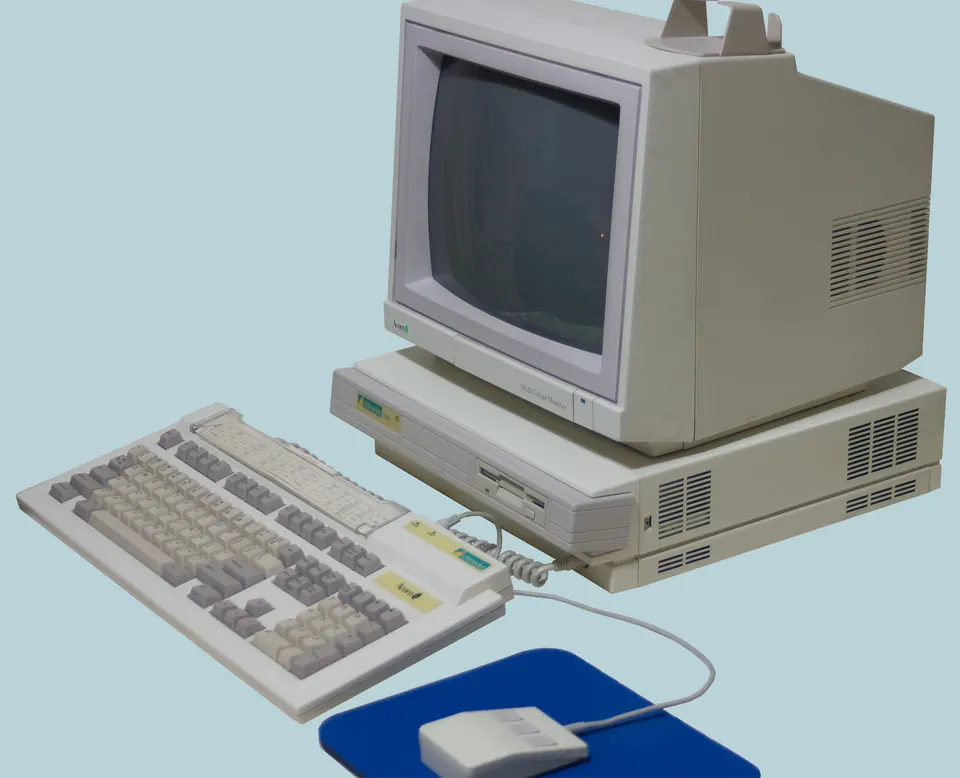
Image: PaulVernon1974 · CC0

The computer that introduced Acorn's own ARM processor — the RISC architecture now sitting in nearly every phone on Earth. Launched in 1987 running RISC OS from a desktop, it was startlingly fast for its price, and startlingly ignored outside British schools and enthusiasts.
Its calling card was Zarch, David Braben's fractal-landscape shooter, whose smooth filled-3D terrain looked like a machine from years in the future — which, in a sense, it was.
What it cost
roughly 85% of a month's pay in 1987 · about $3,623 today
| UK Archimedes 305 launch price (£800, £899 color) |
£800 (1987)
World’s first general-purpose personal computer powered by the ARM 32-bit RISC architecture. |
|---|---|
| Typical street price | — No verified mass-market street price recorded yet. |
| Units sold | ≈500,000 estimate Estimated 500,000 units sold. |
Why it mattered
Its ARM chip is why the Archimedes matters far beyond its small sales: that instruction set went on to power billions of phones and tablets, and eventually Apple's own Macs. Few machines have a legacy so out of proportion to their reach.
Emulating it today
| Emulators | Arculator, RPCEmu, MAME |
|---|---|
| Setup effort | Easy to run (3 on this site's scale) |
| Controls | This is a computer-like platform: games may use a joystick or pad, but launching and configuring software often needs a keyboard. |
| Runs on a handheld | Yes |
The emulator names above are starting points, not a promise that every title or accessory behaves identically. Computer platforms usually add model selection, disk handling and keyboard setup even when CPU emulation itself is mature.
RISC OS ROM (RISC OS 3.11)
The Acorn Archimedes was built around Acorn's ARM processor and the RISC OS desktop operating system, stored entirely on motherboard ROM chips (usually 2 MB). Emulators require a clean dump of RISC OS (typically version 3.11) to boot the desktop and run games.
How many files you need: 1. A single concatenated 2 MB ROM file (e.g. RISC_OS_3.11.rom) or a set of 4 512KB ROM dumps.
Where it stands legally: RISC OS 3.11 and later versions are licensed by RISC OS Developments / 3QD Developments. Commercial ROM packages are available through Cloanto or Retro-Kit.
Legitimate source: RISC OS Open Documentation
Firmware details checked 2026-08. Emulator requirements change — see Arculator Archimedes Documentation for the current list.
Where the software is
TOSEC catalogues computer disks and tapes broadly, including many revisions. It is useful for preservation, while a smaller curated selection is usually easier to play.
Copyright: Commercial software remains copyrighted unless its owner explicitly released or relicensed it. Homebrew, public-domain programs and current reissues should be treated separately from abandoned commercial titles.
This site names preservation projects and explains what they are. It does not link to ROM downloads.
Where to start
- Zarch 1987 shooter
David Braben's fractal-landscape blaster; the demo that sold the machine's raw power.
- Elite 1991 space trading
The definitive home version, fast and filled in where the 8-bit ones were wireframe.
- Star Fighter 3000 1994 combat flight
- Chocks Away 1990 flight sim
- Lander 1987 shooter
Bundled with every machine; Zarch's ancestor.
- E-Type 1989 racing
The verdict
Worth a look for Zarch and its successors and the novelty of RISC OS; the library beyond a few showcases is thin.
If you did not grow up with one in a British classroom, much of its catalogue feels like homework rather than a reason to return.
- Worth it if
- Players curious about acorn and the british micro scene and willing to learn how the original machine worked.
- Not for
- Anyone who wants a large, instantly accessible library and no model, firmware or control decisions.
Scored 3/5 for fun today and 3/5 for historical importance. Those two scores decide the label at the top — a machine can matter enormously and still be no fun.
Read more & watch
This page is 50% complete against the facts we try to record for every system. Gaps are shown as gaps.