1992 · Commodore · US · computer
Commodore Amiga 1200
Commodore's last home Amiga, a fine machine arriving as the home-computer era ended.
Mixed Easy to run Needs a keyboard ▶ Watch on YouTube ↗
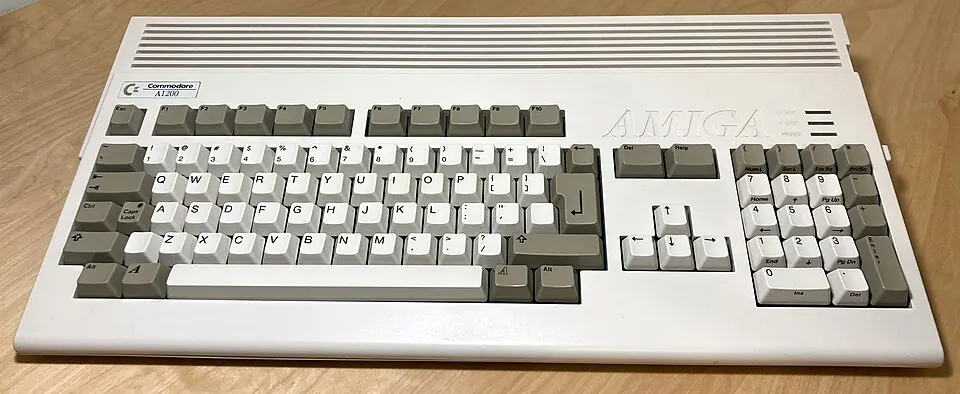
Commodore's 1992 attempt to modernise the Amiga, with the AGA chipset lifting the colour palette into the thousands and a faster 68020 behind it. It arrived to a home-computer market already draining toward the PC and the console, and Commodore was bankrupt within two years.
Frontier: Elite II gave the machine its showcase — a whole simulated galaxy you could fly across seamlessly, from planet surface to open space.
Under the hood
- CPU
- Motorola 68EC020 @ 14.28 MHz
- Sound chip
- MOS 8364 Paula — 4 DMA channels of 8-bit PCM, panned stereo
- Graphics
- AGA chipset — 256 on-screen colours from 16.8 million, plus HAM8
What it cost
roughly a third of a month’s pay in 1992 · about $1,579 today
| UK launch price (£399) |
£399 (1992)
32-bit AGA (Advanced Graphics Architecture) chipset with 256 colors from a 16.7M palette. |
|---|---|
| Typical street price | — No verified mass-market street price recorded yet. |
| US launch list price ($599) | $599 |
| Units sold | ≈1,000,000 estimate Approximately 1 million units sold. |
Why it mattered
The A1200 was the machine a generation of European bedroom coders graduated to, and the last Amiga to matter before Commodore collapsed — the end of a line that had defined home computing on the continent.
Emulating it today
| Emulators | PUAE (libretro), FS-UAE, WinUAE |
|---|---|
| Setup effort | Easy to run (3 on this site's scale) |
| Controls | This is a computer-like platform: games may use a joystick or pad, but launching and configuring software often needs a keyboard. |
| Runs on a handheld | Yes |
The emulator names above are starting points, not a promise that every title or accessory behaves identically. Computer platforms usually add model selection, disk handling and keyboard setup even when CPU emulation itself is mature.
system firmware or BIOS
Firmware is the startup code copied from chips in the original hardware. The emulator needs it before software can boot.
How many files you need: 1. Start with the firmware for the exact model and region you are emulating; some families need additional revisions for later models.
Where it stands legally: Firmware normally remains copyrighted. The clean route is to extract it from hardware you own unless the rights holder offers a download or licensed package.
Firmware details checked 2026-08. Emulator requirements change — see Libretro documentation for the current list.
Where the software is
TOSEC catalogues computer disks and tapes broadly, including many revisions. It is useful for preservation, while a smaller curated selection is usually easier to play.
Copyright: Commercial software remains copyrighted unless its owner explicitly released or relicensed it. Homebrew, public-domain programs and current reissues should be treated separately from abandoned commercial titles.
This site names preservation projects and explains what they are. It does not link to ROM downloads.
Where to start
- Frontier: Elite II 1993 space trading
- The Chaos Engine 1993 run and gun
- Alien Breed 3D 1995 first-person shooter
A Doom of sorts, running on a stock Amiga without a 3D chip in sight.
- Superfrog 1993 platformer
- Zool 2 1993 platformer
- Slam Tilt 1996 pinball
- Banshee 1994 shoot 'em up
The verdict
For AGA showpieces like Frontier: Elite II and the demoscene; it needs the same Kickstart-and-WHDLoad ritual as any Amiga.
If you just want the classic Amiga games, the A500 is the machine most were written for — come here for the later, flashier ones.
- Worth it if
- Players curious about commodore amiga family and willing to learn how the original machine worked.
- Not for
- Anyone who wants a large, instantly accessible library and no model, firmware or control decisions.
Scored 3/5 for fun today and 3/5 for historical importance. Those two scores decide the label at the top — a machine can matter enormously and still be no fun.
Read more & watch
This page is 50% complete against the facts we try to record for every system. Gaps are shown as gaps.