1986 · Apple · US · computer
Apple IIGS
A 16-bit Apple II with studio-grade sound, deliberately held back to protect the Mac.
Mixed Easy to run Needs a keyboard ▶ Watch on YouTube ↗
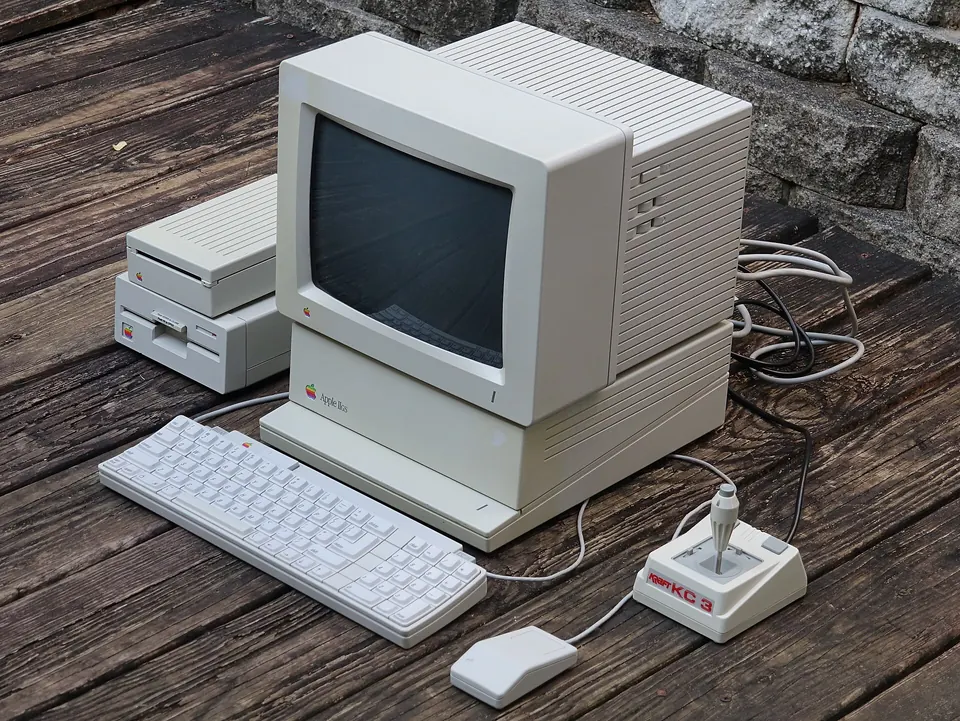
Image: Ruben de Rijcke · CC BY-SA 4.0

Apple's 1986 hybrid: a 16-bit machine that kept the Apple II's software but added an Ensoniq synthesiser and a colour desktop borrowed from the Mac. It was good enough that Apple deliberately held it back, unwilling to let it outshine the Macintosh it was selling at a premium.
That Ensoniq chip gave its games a richness of sound years ahead of its rivals, even as the platform was left to wither.
Under the hood
- CPU
- WDC 65C816 @ 2.8 MHz
- Sound chip
- Ensoniq 5503 DOC — 32-voice wavetable synthesiser
- Graphics
- 320 × 200 / 640 × 200, up to 256 colours from a palette of 4,096
What it cost
about half a month’s pay in 1986 · about $2,859 today
| US launch list price ($999, base system only) |
$999 (1986)
16-bit 65C816 processor, 4096-color graphics, and 32-oscillator Ensoniq wavetable synthesizer. |
|---|---|
| Typical street price | — No verified mass-market street price recorded yet. |
| Units sold | ≈1,250,000 estimate 1.25 million units sold. |
Why it mattered
The IIGS shows Apple caught between two products it feared would compete: a capable 16-bit machine held back to protect the Macintosh. It is a lesson in how corporate strategy can strangle good hardware.
Emulating it today
| Emulators | KEGS, GSplus, Sweet16, MAME |
|---|---|
| Setup effort | Easy to run (3 on this site's scale) |
| Controls | This is a computer-like platform: games may use a joystick or pad, but launching and configuring software often needs a keyboard. |
| Runs on a handheld | Yes |
The emulator names above are starting points, not a promise that every title or accessory behaves identically. Computer platforms usually add model selection, disk handling and keyboard setup even when CPU emulation itself is mature.
Apple IIGS System ROM (ROM01 / ROM03)
The Apple IIGS contains a sophisticated 16-bit toolbox and operating system in ROM, including the Ensoniq DOC 5503 sound synthesizer firmware and QuickDraw II graphics routines. Emulators like KEGS and GSplus cannot boot without an authentic ROM dump (ROM01 or ROM03).
How many files you need: 1. One file: either Apple IIGS ROM 01 (128 KB) or ROM 03 (256 KB).
Where it stands legally: Apple IIGS ROMs are copyrighted by Apple Inc. and must be dumped from physical Apple IIGS hardware.
Firmware details checked 2026-08. Emulator requirements change — see KEGS Apple IIGS Emulator Documentation for the current list.
Where the software is
TOSEC catalogues computer disks and tapes broadly, including many revisions. It is useful for preservation, while a smaller curated selection is usually easier to play.
Copyright: Commercial software remains copyrighted unless its owner explicitly released or relicensed it. Homebrew, public-domain programs and current reissues should be treated separately from abandoned commercial titles.
This site names preservation projects and explains what they are. It does not link to ROM downloads.
Where to start
- The Immortal 1990 action RPG
- Zany Golf 1988 sports
An early Will Wright / Cinemaware oddity built around the machine's sound and colour.
- Space Ace 1990 interactive movie
- Task Force 1988 shooter
- Tower of Myraglen 1987 action RPG
The verdict
Worth it for the Ensoniq sound and a small run of colourful games; the library is smaller than the Apple II's.
Apple's deliberate hobbling means it fell short of its potential — for the deeper library, the plain Apple II is the better trip.
- Worth it if
- Players curious about apple and the ibm pc and willing to learn how the original machine worked.
- Not for
- Anyone who wants a large, instantly accessible library and no model, firmware or control decisions.
Scored 3/5 for fun today and 3/5 for historical importance. Those two scores decide the label at the top — a machine can matter enormously and still be no fun.
Read more & watch
This page is 50% complete against the facts we try to record for every system. Gaps are shown as gaps.