1979 · Atari · US · computer
Atari 400/800 and XL/XE
The first home computers built around custom co-processor chips, and it showed.
Mixed Easy to run Needs a keyboard ▶ Watch on YouTube ↗
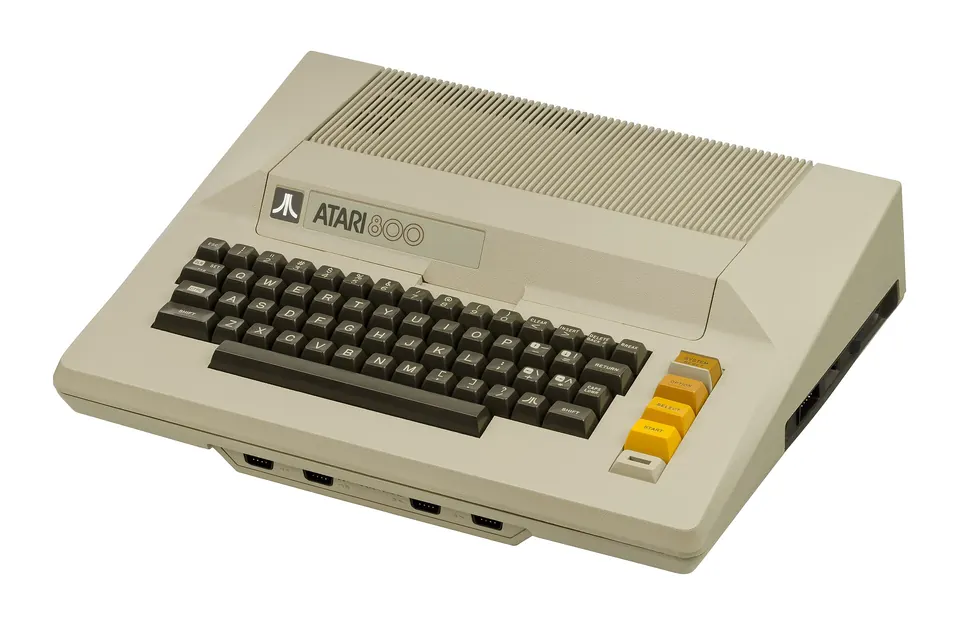
Image: Evan-Amos · Public domain

The 400 and 800, launched in 1979, were among the earliest home computers built around custom co-processor chips — ANTIC, GTIA and POKEY handling graphics and sound so the CPU did not have to. The result outran rivals at games and held its ground for years.
Its defining game was Star Raiders, a first-person space war of a depth nobody else managed at home until much later; M.U.L.E. and Rescue on Fractalus followed.
Under the hood
- CPU
- MOS 6502 @ 1.79 MHz
- Memory
- 8 KB at launch (raised from a planned 4 KB; later XL/XE models offered far more)
What it cost
about a quarter of a month’s pay in 1983 · about $627 today
| US Atari 800 launch price ($999.99 for 8KB model) |
$999.99 (1979)
about a month of an average wage · about $4,321 in today's money |
|---|---|
| Atari 800XL price ($199) | $199 (1983) |
| Units sold | ≈4,000,000 estimate Over 4 million units sold across 400, 800, XL, and XE lines. |
Why it mattered
Atari's custom-chip design set the template the company reused from the 2600 to the ST, and gave home users arcade-grade graphics and sound years early — a machine whose influence ran right through Atari's history.
Emulating it today
| Emulators | Altirra, Atari800 (libretro), Atari800 |
|---|---|
| Setup effort | Easy to run (2 on this site's scale) |
| Controls | This is a computer-like platform: games may use a joystick or pad, but launching and configuring software often needs a keyboard. |
| Runs on a handheld | Yes |
Altirra (Windows) is the accuracy reference for the whole Atari 8-bit line, with Atari800 as the cross-platform and libretro option. The friction is configuration — selecting the machine model (400/800 vs XL/XE) and memory size, and handling disk (ATR) and cassette images — not CPU emulation, which is mature.
Atari OS & BASIC ROMs (ATARIXL.ROM, ATARIBAS.ROM)
Atari 8-bit computers require the Operating System ROM (10 KB / 16 KB) and the Atari BASIC revision ROM (8 KB). While the Altirra emulator features an excellent built-in open-source BIOS replacement, RetroArch and traditional emulators require ATARIXL.ROM and ATARIBAS.ROM to boot disk images.
How many files you need: 2. Two files: ATARIXL.ROM (16 KB OS for XL/XE models) and ATARIBAS.ROM (8 KB BASIC cartridge ROM).
Where it stands legally: Atari OS ROMs are copyrighted by Atari Interactive. AltirraOS provides an open-source alternative.
Firmware details checked 2026-08. Emulator requirements change — see Atari 8-bit emulators — Emulation General Wiki for the current list.
Where the software is
TOSEC catalogues computer disks and tapes broadly, including many revisions. It is useful for preservation, while a smaller curated selection is usually easier to play.
Copyright: Commercial software remains copyrighted unless its owner explicitly released or relicensed it. Homebrew, public-domain programs and current reissues should be treated separately from abandoned commercial titles.
This site names preservation projects and explains what they are. It does not link to ROM downloads.
Where to start
- Star Raiders 1979 space combat
The killer app: a first-person space war years before anyone else managed one at home.
- M.U.L.E. 1983 strategy
A four-player economics game that has never really been bettered.
- Rescue on Fractalus! 1985 combat flight
Lucasfilm's fractal planet, and its famous jump-scare alien.
- Ballblazer 1985 sports
- Archon: The Light and the Dark 1983 strategy
- Boulder Dash 1984 puzzle
- Alternate Reality: The City 1985 RPG
The verdict
A rich library led by Star Raiders and M.U.L.E. and a friendly emulation target; one of the most rewarding 8-bit computers.
Tape and disk loading and the odd copy-protection scheme are part of the experience — expect some setup before the fun starts.
- Worth it if
- Players curious about atari computers and handheld and willing to learn how the original machine worked.
- Not for
- Anyone who wants a large, instantly accessible library and no model, firmware or control decisions.
Scored 3/5 for fun today and 3/5 for historical importance. Those two scores decide the label at the top — a machine can matter enormously and still be no fun.
Read more & watch
This page is 75% complete against the facts we try to record for every system. Gaps are shown as gaps.