1981 · Acorn Computers · UK · computer
Acorn BBC Micro
When the British Broadcasting Corporation launched its Computer Literacy Project in 1981, they chose Acorn’s rugged microcomputer.
Rewarding Easy to run Needs a keyboard ▶ Watch on YouTube ↗
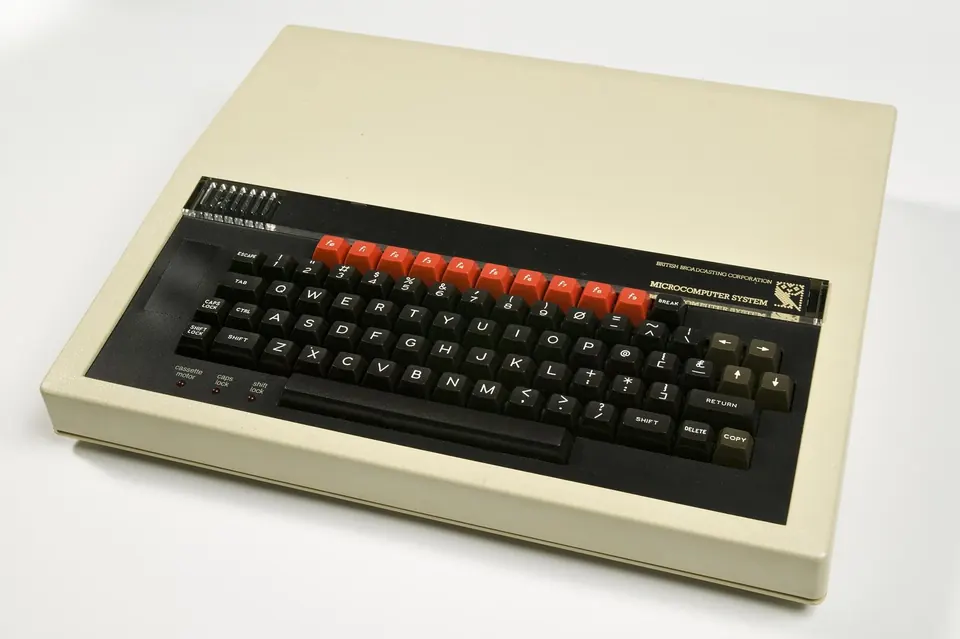
When the British Broadcasting Corporation launched its Computer Literacy Project in 1981, they chose Acorn’s rugged microcomputer. Acorn’s engineering team (led by Sophie Wilson and Steve Furber) went on to invent the ARM processor architecture that powers nearly all modern smartphones.
David Braben and Ian Bell developed Elite on the BBC Micro in 1984, squeezing eight galaxies of 256 procedurally generated planetary systems and 3D wireframe space dogfighting into just 22 KB of free memory.
Under the hood
- CPU
- MOS 6502A @ 2.0 MHz (Unusually fast for 1981) with 32 KB RAM
- Sound chip
- Texas Instruments SN76489 (3 channels + noise)
- Graphics
- Motorola 6845 CRTC: Mode 1 (320×256, 4 colors), Mode 2 (160×256, 8 colors), Mode 7 (Teletext 40×25)
- Media
- 5¼" Floppy Disk System (DFS/ADFS) & Cassette Tape
What it cost
about half a month’s pay in 1981 · about $2,084 today
| UK launch price (£299 Model A, £399 Model B) |
£299 (1981)
Commissioned for the BBC Computer Literacy Project and built by Acorn. |
|---|---|
| Typical street price | — No verified mass-market street price recorded yet. |
| Units sold | ≈1,500,000 estimate 1.5 million units sold, dominated UK classrooms. |
Why it mattered
David Braben and Ian Bell developed Elite on the BBC Micro in 1984, squeezing eight galaxies of 256 procedurally generated planetary systems and 3D wireframe space dogfighting into just 22 KB of free memory.
Emulating it today
| Emulators | BeebEm, b-em, MAME |
|---|---|
| Setup effort | Easy to run (2.5 on this site's scale) |
| Controls | The original software assumes a keyboard. A desktop setup feels natural; on a handheld, map common keys and keep an on-screen keyboard available. |
| Runs on a handheld | Yes |
Uses RetroArch b-em or MAME cores. Disk images (.ssd / .dsd) and tape files (.uef) load via BBC BASIC commands (*CAT, CH."GAME"). The emulator names above are starting points, not a promise that every title or accessory behaves identically. Computer platforms usually add model selection, disk handling and keyboard setup even when CPU emulation itself is mature.
BBC MOS & BASIC ROM (os12.rom, basic2.rom)
The Acorn BBC Micro boots directly from internal ROM containing the Machine Operating System (MOS) and BBC BASIC interpreter. Emulators require dumps of the 16 KB MOS ROM and 16 KB BASIC ROM to provide the system environment and disk filing system.
How many files you need: 2. Two ROM images: the MOS kernel (os12.rom or os2.rom) and BASIC interpreter (basic2.rom).
Where it stands legally: Acorn / BBC MOS and BBC BASIC ROMs have been made freely available for non-commercial emulation use with permission from the rights holders.
Firmware details checked 2026-08. Emulator requirements change — see B-em BBC Micro Emulator Documentation for the current list.
Where the software is
TOSEC catalogues computer disks and tapes broadly, including many revisions. It is useful for preservation, while a smaller curated selection is usually easier to play.
Copyright: Commercial software remains copyrighted unless its owner explicitly released or relicensed it. Homebrew, public-domain programs and current reissues should be treated separately from abandoned commercial titles.
This site names preservation projects and explains what they are. It does not link to ROM downloads.
Where to start
- Elite 3D Space Trading & Combat
The legendary procedural universe that invented 3D space flight simulators.
- Repton 1–3 Action Puzzle
Acornsoft’s beloved diamond-collecting, boulder-falling puzzle series.
- Chuckie Egg Platformer
One of the fastest, smoothest versions of the egg-snatching classic.
- Citadel Platform Adventure
Explore castles, cast spells, and solve environmental puzzles.
- Exile Sci-Fi Gravity Physics Adventure
Astonishing Newtonian physics, wind currents, and open cave exploration in 1988.
The verdict
The computer commissioned by the BBC for the British Computer Literacy Project. Exceptional build quality, rock-solid keyboard, and the birthplace of 3D space combat in Elite.
The strongest software can be rewarding, but original controls and setup assumptions may matter more than screenshots suggest.
- Worth it if
- Players curious about acorn and the british micro scene and willing to learn how the original machine worked.
- Not for
- Anyone who wants a large, instantly accessible library and no model, firmware or control decisions.
Scored 3/5 for fun today and 4/5 for historical importance. Those two scores decide the label at the top — a machine can matter enormously and still be no fun.
Read more & watch
This page is 50% complete against the facts we try to record for every system. Gaps are shown as gaps.