1982 · Coleco · US · console
ColecoVision
Coleco stormed the market in August 1982 by securing the exclusive home console rights to Nintendo’s arcade sensation Donkey Kong as the pack-in game,…
Rewarding Easy to run ▶ Watch on YouTube ↗
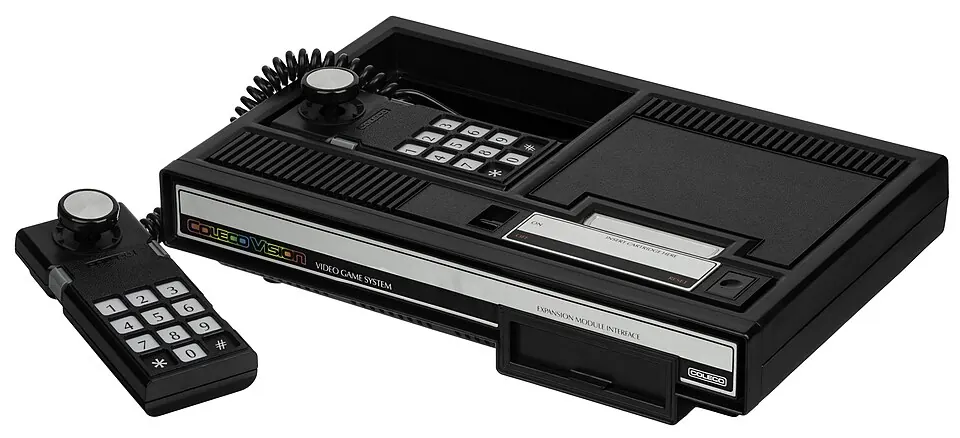
Coleco stormed the market in August 1982 by securing the exclusive home console rights to Nintendo’s arcade sensation Donkey Kong as the pack-in game, delivering graphics that blew away the Atari 2600 and Intellivision.
Coleco’s hardware was so close to standard arcade and MSX architecture that its ports were unmatched. They even sold an Expansion Module that let ColecoVision owners play actual Atari 2600 cartridges.
Under the hood
- CPU
- Zilog Z80A @ 3.58 MHz with 1 KB RAM + 16 KB VRAM
- Sound chip
- Texas Instruments SN76489A (3 tone channels + 1 noise)
- Graphics
- Texas Instruments TMS9928A, 256 × 192, 16 colors, 32 sprites
- Media
- ROM Cartridges & Expansion Module #1 (Plays Atari 2600 games!)
What it cost
about 14% of a month’s pay in 1982 · about $569 today
| US launch list price ($175 with Donkey Kong) | $175 (1982) |
|---|---|
| Typical street price | — No verified mass-market street price recorded yet. |
| Units sold | ≈2,000,000 estimate Over 2 million units sold before the 1983 crash. |
Why it mattered
Coleco’s hardware was so close to standard arcade and MSX architecture that its ports were unmatched. They even sold an Expansion Module that let ColecoVision owners play actual Atari 2600 cartridges.
Emulating it today
| Emulators | Gearcoleco, ColEm, FBNeo |
|---|---|
| Setup effort | Easy to run (2.5 on this site's scale) |
| Controls | The original controller does not map perfectly to a standard modern pad; expect to customize controls. |
| Runs on a handheld | Yes |
Requires the `coleco.rom` (8 KB) BIOS file in RetroArch Gearcoleco or Bluemsx cores. Keypad inputs are easily mapped to shoulder buttons or right analog stick. The emulator names above are starting points, not a promise that every title or accessory behaves identically. Computer platforms usually add model selection, disk handling and keyboard setup even when CPU emulation itself is mature.
system firmware or BIOS
Requires `coleco.rom` (8,192 bytes, SHA1: `3aa93ef441038472f75962e26922883017a523ea`) in BIOS directory.
How many files you need: 1. Start with the firmware for the exact model and region you are emulating; some families need additional revisions for later models.
Where it stands legally: Firmware normally remains copyrighted. The clean route is to extract it from hardware you own unless the rights holder offers a download or licensed package.
Firmware details checked 2026-08. Emulator requirements change — see Libretro documentation for the current list.
Where the software is
Preservation catalogues describe verified dumps; they do not grant permission to download commercial software. A curated, correctly matched set is easier to use than an undifferentiated archive.
Copyright: Commercial software remains copyrighted unless its owner explicitly released or relicensed it. Homebrew, public-domain programs and current reissues should be treated separately from abandoned commercial titles.
This site names preservation projects and explains what they are. It does not link to ROM downloads.
Where to start
- Donkey Kong Arcade Platformer
The legendary pack-in port that sold millions of consoles.
- Zaxxon Isometric Shooter
Sega’s isometric space combat with altitude shadow mechanics.
- Lady Bug Maze Action
Fast-paced maze game featuring turnstile doors and letter multiplier bonuses.
- Venture Dungeon Action
Explore rooms, snatch treasure, and escape Hall Monsters with bow and arrows.
- Mr. Do! Arcade Action
Dig tunnels and drop apples on enemies in this arcade gem.
- Pitfall II: Lost Caverns Platform Adventure
Enhanced audio and expanded underground caverns.
- Time Pilot 360° Shooter
Konami’s time-traveling fighter plane dogfight.
The verdict
The near-arcade-perfect console of 1982. Packed with authentic Nintendo and arcade licenses (Donkey Kong, Zaxxon, Lady Bug, Venture).
The strongest software can be rewarding, but original controls and setup assumptions may matter more than screenshots suggest.
- Worth it if
- Players curious about the second wave, before the crash and willing to learn how the original machine worked.
- Not for
- Anyone who wants a large, instantly accessible library and no model, firmware or control decisions.
Scored 3/5 for fun today and 4/5 for historical importance. Those two scores decide the label at the top — a machine can matter enormously and still be no fun.
Read more & watch
This page is 50% complete against the facts we try to record for every system. Gaps are shown as gaps.