1976 · Fairchild Semiconductor · US · console
Fairchild Channel F
The unsung pioneer of home gaming.
Skip it Easy to run ▶ Watch on YouTube ↗
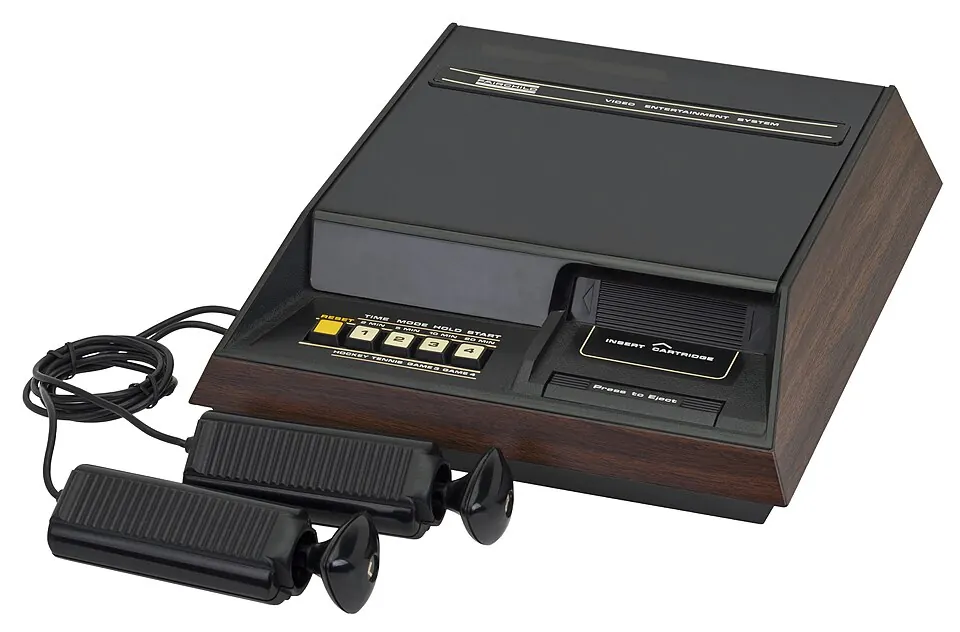
The unsung pioneer of home gaming. Designed by Jerry Lawson, the Channel F was the very first video game console powered by a microprocessor that played swappable ROM cartridges, pre-dating the Atari 2600.
Before the Channel F, video game systems were dedicated hardware hardcoded to one or a few built-in games (like Pong). The Channel F proved that software cartridges were the future.
Under the hood
- CPU
- Fairchild F8 @ 1.79 MHz
- Sound chip
- Single-tone beeper built into console speaker
- Graphics
- 102 × 58 resolution, 4 visible colors
- Memory
- 2 KB
- Media
- Videocart Cartridges (First ever swappable ROM carts)
What it cost
about a quarter of a month’s pay in 1976 · about $937 today
| US launch list price ($169.95) |
$169.95 (1976)
World’s first programmable ROM cartridge home video game console. |
|---|---|
| Typical street price | — No verified mass-market street price recorded yet. |
| Units sold | ≈350,000 estimate Approximately 350,000 units sold. |
What it's worth now
High $100–200 working, $400+ complete-in-box
The first cartridge-based console — a museum piece whose historical importance to serious collectors outweighs its gameplay.
A guide to collectibility, not a valuation — real prices depend on condition, completeness and demand.
Why it mattered
Before the Channel F, video game systems were dedicated hardware hardcoded to one or a few built-in games (like Pong). The Channel F proved that software cartridges were the future.
Emulating it today
| Emulators | FreeChaF (libretro), MESS, MAME |
|---|---|
| Setup effort | Easy to run (2.5 on this site's scale) |
| Controls | The original controller does not map perfectly to a standard modern pad; expect to customize controls. |
| Runs on a handheld | Yes |
FreeChaF (a libretro core) and MAME both emulate the Channel F well; it is a simple F8-based cartridge machine with no BIOS, so setup is install-and-run. Historically the first cartridge console, but trivial to emulate today.
system firmware or BIOS
Needs Fairchild system ROMs (channel f BIOS). In MAME/RetroArch, place `channelf.zip` in system directory.
How many files you need: 1. Start with the firmware for the exact model and region you are emulating; some families need additional revisions for later models.
Where it stands legally: Firmware normally remains copyrighted. The clean route is to extract it from hardware you own unless the rights holder offers a download or licensed package.
Firmware details checked 2026-08. Emulator requirements change — see Fairchild Channel F emulators — Emulation General Wiki for the current list.
Where the software is
Preservation catalogues describe verified dumps; they do not grant permission to download commercial software. A curated, correctly matched set is easier to use than an undifferentiated archive.
Copyright: Commercial software remains copyrighted unless its owner explicitly released or relicensed it. Homebrew, public-domain programs and current reissues should be treated separately from abandoned commercial titles.
This site names preservation projects and explains what they are. It does not link to ROM downloads.
Where to start
- Videocart 1: Tic-Tac-Toe / Shooting Gallery Action / Puzzle
The pack-in cartridge with early 4-color gameplay.
- Videocart 3: Blackjack Card Game
One of the earliest AI computer card players in a home.
- Videocart 12: Baseball Sports
Impressive for 1977 multi-directional pitching.
- Videocart 18: Bowling Sports
Surprisingly fun physics-based trajectory control.
The verdict
Historically pivotal as an early microprocessor ROM cartridge console, but games are rudimentary Pong and tic-tac-toe variants that wear off in 5 minutes.
The strongest software can be rewarding, but original controls and setup assumptions may matter more than screenshots suggest.
- Worth it if
- Players curious about the first cartridge consoles and willing to learn how the original machine worked.
- Not for
- Anyone who wants a large, instantly accessible library and no model, firmware or control decisions.
Scored 1/5 for fun today and 2/5 for historical importance. Those two scores decide the label at the top — a machine can matter enormously and still be no fun.
Read more & watch
This page is 50% complete against the facts we try to record for every system. Gaps are shown as gaps.