1980 · Nintendo · Japan · handheld
Nintendo Game & Watch
Single-game LCD handhelds that funded Nintendo's rise and introduced the D-pad.
Mixed Trivial to run ▶ Watch on YouTube ↗
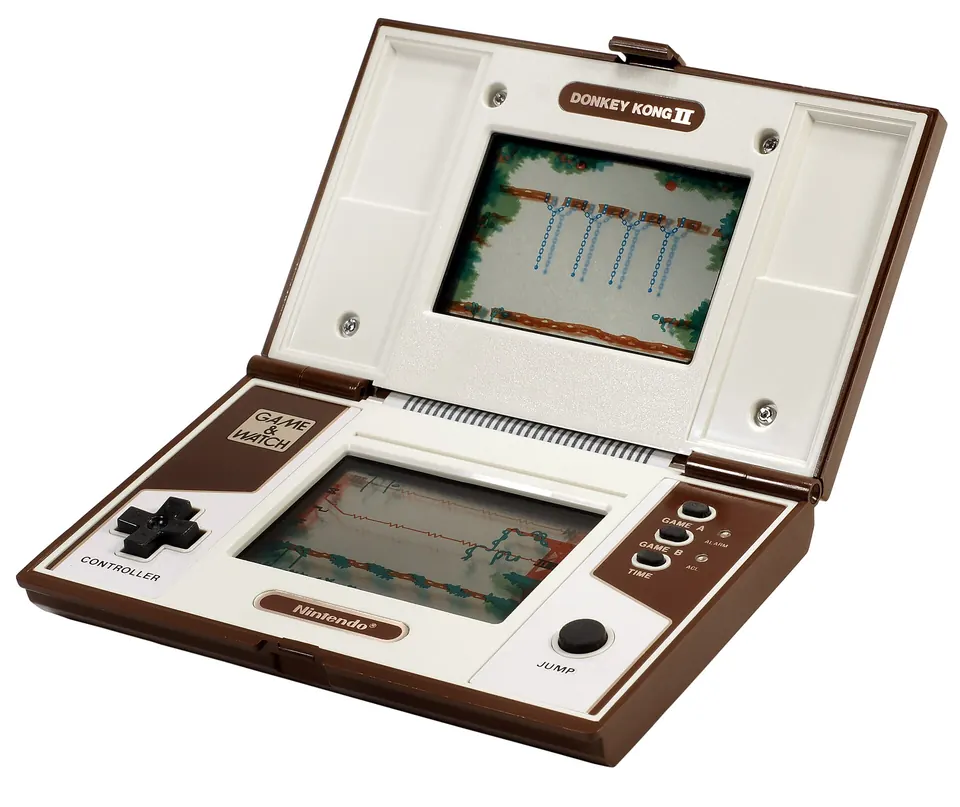
Image: Evan-Amos · Public domain

Gunpei Yokoi's line of single-game LCD handhelds, made from 1980 to 1991, each a fixed liquid-crystal scene animated by a watch chip. They were cheap, ubiquitous, and profitable enough to fund Nintendo's rise into video games.
The dual-screen Donkey Kong unit introduced the cross-shaped D-pad and, decades later, lent its hinged shape to the Nintendo DS.
What it cost
a rounding error against a month’s pay in 1980 · about $97 today
| Japan Ball launch price (¥5,800 / $29.95 USD in US) |
¥5,800 (1980)
Gunpei Yokoi’s calculator-chip LCD handhelds with alarm clock. |
|---|---|
| Typical street price | — No verified mass-market street price recorded yet. |
| Units sold | 43,400,000 43.4 million units sold worldwide across 60 games. |
Why it mattered
Gunpei Yokoi's Game & Watch funded Nintendo's leap into video games, introduced the cross-shaped D-pad every controller since has copied, and taught the company the design discipline that produced the Game Boy.
Emulating it today
| Emulators | GW (libretro), MAME, Madrigal CDZ |
|---|---|
| Setup effort | Trivial to run (0 on this site's scale) |
| Controls | A standard modern controller covers the ordinary controls, though unusual accessories may need custom mapping. |
| Runs on a handheld | Yes |
The emulator names above are starting points, not a promise that every title or accessory behaves identically. Computer platforms usually add model selection, disk handling and keyboard setup even when CPU emulation itself is mature.
Firmware
This system needs no firmware file. Install an emulator, open a game, and it runs.
How many files you need: none to go and find. No separate firmware file is needed for an ordinary setup.
Firmware details checked 2026-08. Emulator requirements change — see Libretro documentation for the current list.
Where the software is
Preservation catalogues describe verified dumps; they do not grant permission to download commercial software. A curated, correctly matched set is easier to use than an undifferentiated archive.
Copyright: Commercial software remains copyrighted unless its owner explicitly released or relicensed it. Homebrew, public-domain programs and current reissues should be treated separately from abandoned commercial titles.
This site names preservation projects and explains what they are. It does not link to ROM downloads.
Where to start
- Ball 1980 action
The very first Game & Watch, a single juggling routine in an LCD.
- Donkey Kong 1982 platformer
The dual-screen unit whose hinge became the DS twenty years later.
- Fire 1980 action
- Oil Panic 1982 action
- Mario Bros. 1983 action
The verdict
Charming in short bursts and historically essential; each unit is a single fixed game.
These are one-trick toys by design — a few minutes each, not a library to sink into.
- Worth it if
- Players curious about nintendo handhelds and willing to learn how the original machine worked.
- Not for
- Anyone who wants a large, instantly accessible library and no model, firmware or control decisions.
Scored 3/5 for fun today and 3/5 for historical importance. Those two scores decide the label at the top — a machine can matter enormously and still be no fun.
Read more & watch
This page is 50% complete against the facts we try to record for every system. Gaps are shown as gaps.