2001 · Nintendo · Japan · handheld
Nintendo Game Boy Advance
The Game Boy Advance was the spiritual successor to the 16-bit 2D golden age.
Essential Trivial to run ▶ Watch on YouTube ↗
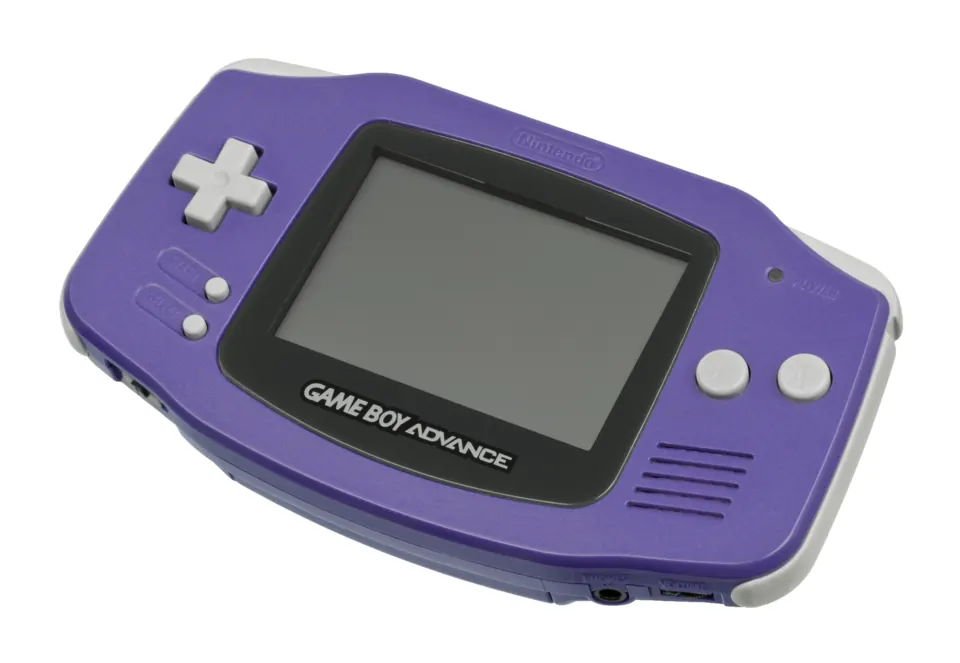
The Game Boy Advance was the spiritual successor to the 16-bit 2D golden age. With its powerful 32-bit ARM processor and gorgeous pixel art capabilities, developers refined the platformer, tactical strategy, and Metroidvania genres to absolute perfection.
The later Game Boy Advance SP introduced a folding clamshell design and front-lit/back-lit screens, setting the template for all future Nintendo dual-screen handhelds.
Under the hood
- CPU
- ARM7TDMI (32-bit RISC) @ 16.78 MHz + Z80 coprocessor for GB/GBC backward compatibility
- Sound chip
- Direct Sound (2 DMA 8-bit sample channels + classic 4-channel Game Boy APU)
- Graphics
- 240 × 160 resolution, 32,768 colors, hardware rotation/scaling background modes (Mode 7 style)
- Media
- GBA Cartridges (Game Paks up to 32 MB)
What it cost
a rounding error against a month’s pay in 2003 · about $136 today
| US launch list price ($99.99) |
$99.99 (2001)
a rounding error against a month’s pay · about $177 in today's money |
|---|---|
| GBA SP front-lit model ($79.99) | $79.99 (2003) |
| Units sold | 81,510,000 81.51 million units worldwide. |
Why it mattered
The later Game Boy Advance SP introduced a folding clamshell design and front-lit/back-lit screens, setting the template for all future Nintendo dual-screen handhelds.
Emulating it today
| Emulators | mGBA, VBA-Next, NanoBoyAdvance |
|---|---|
| Setup effort | Trivial to run (0.5 on this site's scale) |
| Controls | A standard modern controller covers the ordinary controls, though unusual accessories may need custom mapping. |
| Runs on a handheld | Yes |
Flawless plug-and-play emulation on mGBA and VBA-M cores with zero setup needed. The emulator names above are starting points, not a promise that every title or accessory behaves identically. Computer platforms usually add model selection, disk handling and keyboard setup even when CPU emulation itself is mature.
GBA BIOS (gba_bios.bin)
The Game Boy Advance uses a 16 KB boot ROM containing SWI (software interrupt) math routines, decompression algorithms (LZ77, Huffman), and the boot animation. mGBA contains an open-source high-level reimplementation, but using an authentic gba_bios.bin ensures exact CPU timing and flawless compatibility.
How many files you need: 1. One optional 16 KB file: gba_bios.bin.
Where it stands legally: mGBA includes an open-source clean-room BIOS implementation that requires no copyrighted files. The original 16 KB Nintendo BIOS is copyrighted and must be dumped from a GBA console.
Firmware details checked 2026-08. Emulator requirements change — see Libretro — mGBA core documentation for the current list.
Where the software is
Preservation catalogues describe verified dumps; they do not grant permission to download commercial software. A curated, correctly matched set is easier to use than an undifferentiated archive.
Copyright: Commercial software remains copyrighted unless its owner explicitly released or relicensed it. Homebrew, public-domain programs and current reissues should be treated separately from abandoned commercial titles.
This site names preservation projects and explains what they are. It does not link to ROM downloads.
Where to start
- Metroid Fusion & Metroid: Zero Mission Metroidvania
Silky smooth wall jumping, terrifying SA-X encounters, and the definitive remake of the original NES Metroid.
- Castlevania: Aria of Sorrow Action RPG / Metroidvania
Soma Cruz’s Tactical Soul absorption system; widely celebrated as the best GBA Castlevania.
- Pokémon Emerald / FireRed / LeafGreen JRPG / Monster Catcher
The peak of classic 2D Pokémon sprites with the Battle Frontier and Hoenn region.
- Golden Sun & Golden Sun: The Lost Age JRPG
Camelot’s visual marvel with pseudo-3D battle summons and Djinn puzzle mechanics.
- Mother 3 JRPG
Shigesato Itoi’s emotional tour de force with rhythmic combo battle mechanics and fan translation.
- Advance Wars 1 & 2 Turn-based Tactics
Intelligent Systems’ accessible yet deep tactical grid warfare.
- The Legend of Zelda: The Minish Cap Action Adventure
Capcom/Flagship’s gorgeous shrinking adventure with Ezlo the talking hat.
- Mario & Luigi: Superstar Saga Action RPG
Hilarious comedy writing and synchronized dual-button platforming battles.
- Fire Emblem: The Blazing Blade Strategy RPG
Introduced Western players to Marth, Roy, and permadeath tactical strategy.
- Astro Boy: Omega Factor Action Beat 'em up
Treasure’s adrenaline-pumping beam-blasting tribute to Osamu Tezuka.
The verdict
A portable Super Nintendo in your pocket. Brilliant 32-bit pixel art, zero load times, and an embarrassment of riches: Metroid Fusion, Castlevania: Aria of Sorrow, Pokémon Emerald, Golden Sun, and…
The strongest software can be rewarding, but original controls and setup assumptions may matter more than screenshots suggest.
- Worth it if
- Players curious about nintendo handhelds and willing to learn how the original machine worked.
- Not for
- Anyone who wants a large, instantly accessible library and no model, firmware or control decisions.
Scored 5/5 for fun today and 5/5 for historical importance. Those two scores decide the label at the top — a machine can matter enormously and still be no fun.
Read more & watch
This page is 75% complete against the facts we try to record for every system. Gaps are shown as gaps.