1989 · Nintendo · Japan · handheld
Nintendo Game Boy
Gunpei Yokoi embraced "Lateral Thinking with Withered Technology"—choosing an inexpensive monochrome screen that granted 30 hours of battery life over…
Essential Trivial to run ▶ Watch on YouTube ↗
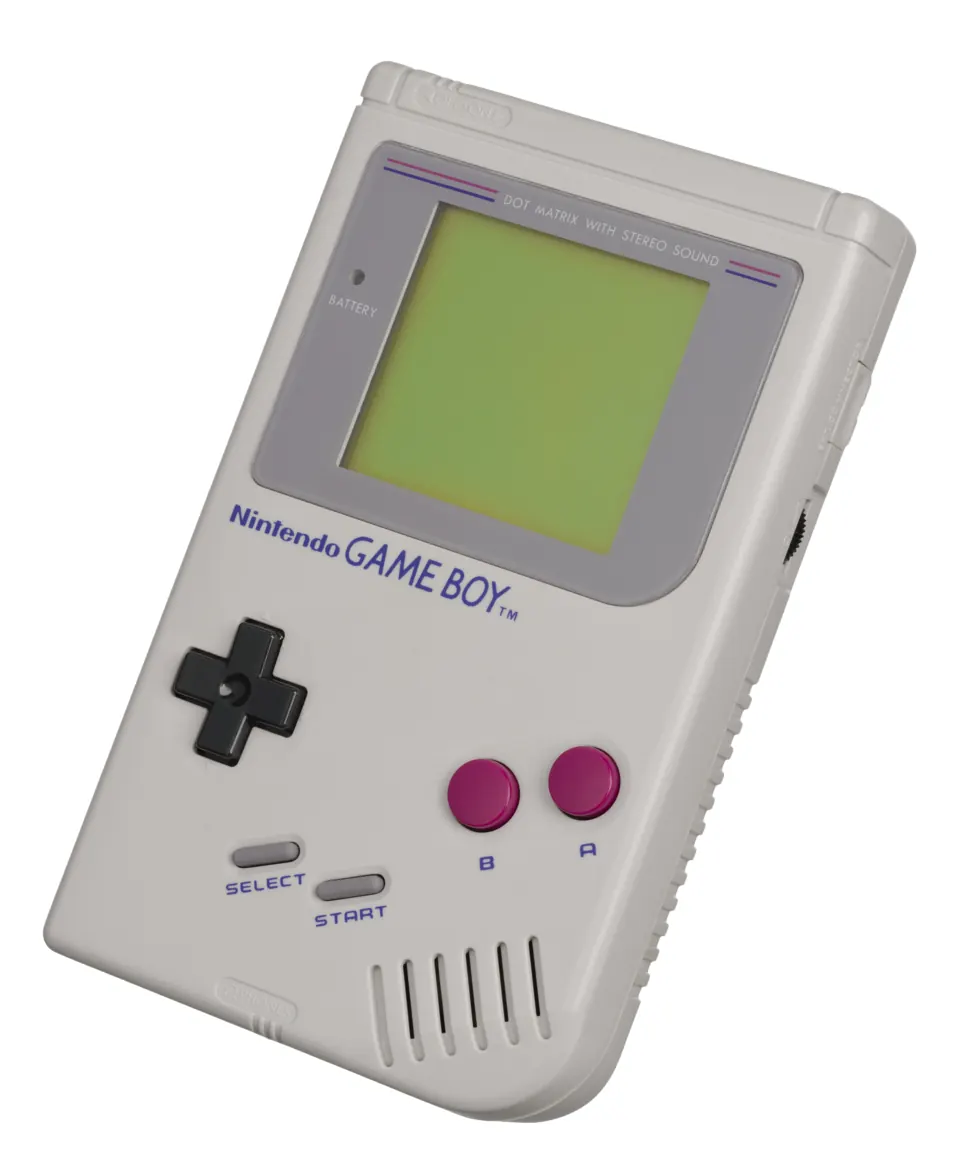
Gunpei Yokoi embraced "Lateral Thinking with Withered Technology"—choosing an inexpensive monochrome screen that granted 30 hours of battery life over battery-guzzling color screens. Bundled with Tetris, it conquered world travel.
In 1996, Satoshi Tajiri’s Pokémon Red and Green revitalized the console, turning the aging 8-bit handheld into the biggest global pop culture phenomenon of the decade.
Under the hood
- CPU
- Sharp LR35902 (Z80 / 8080 hybrid) @ 4.19 MHz (8.38 MHz in GBC mode)
- Sound chip
- Built-in 4-channel sound synthesizer (2 pulse channels, 1 4-bit wavetable, 1 white noise)
- Graphics
- 160 × 144 dot-matrix STN reflective LCD (4 shades of green / 56 colors on GBC)
- Media
- Game Boy Cartridges (Grey/Black/Clear Game Paks)
Hardware revisions
| Model | Years | What changed |
|---|---|---|
| DMG-01Game Boy (original) | Apr 1989 (JP) / Jul 1989 (NA) / 1990 (EU) | Original release; Known issue: No backlight; STN monochrome/green-tinted screen hard to see in low light |
| MGB-001Game Boy Pocket | Jul 1996 (JP) / Sept 1996 (NA) | Smaller and lighter (125g vs 220g), 2xAAA batteries instead of 4xAA; Known issue: Initial production units lacked a power LED, restored in 1997 after criticism |
| CGB-001Game Boy Color | Oct 1998 (JP) / Nov 1998 (NA/EU) | Color TFT screen, 4x RAM, 2x VRAM, backward-compatible with original Game Boy cartridges; Known issue: No backlight — still hard to see in dark environments |
| AGB-001Game Boy Advance | 2001 | Widescreen horizontal form factor, 32-bit hardware; Known issue: No backlight or frontlight — contemporary reviewers called it 'nearly impossible' to play without an external light source |
| AGS-001Game Boy Advance SP (front-lit) | 2003 | Clamshell design with a toggleable built-in front-light; Known issue: Dim/flickering/uneven front-light reported on aging units |
| AGS-101Game Boy Advance SP (backlit) | 2005 | A significant, sought-after upgrade over AGS-001; the case looks identical, only distinguishable by the brighter screen and the -101 code.; Known issue: Same hinge-wear/brittleness issue as AGS-001 (shared shell design) |
| OXY-001Game Boy Micro | Sept 2005 | 2in backlit screen, adjustable brightness, interchangeable faceplates, built-in rechargeable battery; Known issue: Cannot play original Game Boy or Game Boy Color games — no backward compatibility despite a compatible CPU |
What it cost
a rounding error against a month’s pay in 1996 · about $100 today
| US launch list price ($89.95 with Tetris, earphones, cable & batteries) |
$89.95 (1989)
only about 5% of a month’s pay · about $228 in today's money |
|---|---|
| Game Boy Pocket street price ($49.95) | $49.95 (1996) |
| Japan launch price (¥12,500) | ¥12,500 |
| Units sold | 118,690,000 118.69 million units combined across original Game Boy and Game Boy Color. |
What it's worth now
Moderate $40–70 working DMG-01, $150–250 boxed
Later models (Pocket, Color, the Japan-only Light) sit at different price points; sealed units go far beyond the loose range.
A guide to collectibility, not a valuation — real prices depend on condition, completeness and demand.
Why it mattered
In 1996, Satoshi Tajiri’s Pokémon Red and Green revitalized the console, turning the aging 8-bit handheld into the biggest global pop culture phenomenon of the decade.
Emulating it today
| Emulators | SameBoy, Gambatte, mGBA |
|---|---|
| Setup effort | Trivial to run (0 on this site's scale) |
| Controls | A standard modern controller covers the ordinary controls, though unusual accessories may need custom mapping. |
| Runs on a handheld | Yes |
Flawless plug-and-play emulation in SameBoy and Gambatte cores with custom color palette selection. The emulator names above are starting points, not a promise that every title or accessory behaves identically. Computer platforms usually add model selection, disk handling and keyboard setup even when CPU emulation itself is mature.
Firmware
This system needs no firmware file. Install an emulator, open a game, and it runs.
How many files you need: none to go and find. No separate firmware file is needed for an ordinary setup.
Firmware details checked 2026-08. Emulator requirements change — see Libretro documentation for the current list.
Where the software is
Preservation catalogues describe verified dumps; they do not grant permission to download commercial software. A curated, correctly matched set is easier to use than an undifferentiated archive.
Copyright: Commercial software remains copyrighted unless its owner explicitly released or relicensed it. Homebrew, public-domain programs and current reissues should be treated separately from abandoned commercial titles.
This site names preservation projects and explains what they are. It does not link to ROM downloads.
Where to start
- Tetris Puzzle
Alexey Pajitnov’s falling block puzzle that sold 35 million cartridges.
- Pokémon Red / Blue / Yellow JRPG / Monster Catcher
The cultural earthquake that launched the highest-grossing media franchise in history.
- The Legend of Zelda: Link's Awakening (DX) Action Adventure
An emotionally resonant island dream adventure packed into a tiny Game Boy cart.
- Pokémon Gold / Silver / Crystal (GBC) JRPG / Monster Catcher
Satoru Iwata squeezed two full regions (Johto & Kanto) and 16 gym badges into one GBC cart.
- Super Mario Land 2: 6 Golden Coins Platformer
Introduced Wario to the world with rich, expressive Mario sprites.
- Donkey Kong ('94) Puzzle Platformer
Starts like the 1981 arcade game, then unfolds into 101 puzzle-platforming stages.
- Metroid II: Return of Samus Action Adventure
Hunt down 39 Metroids on planet SR388 with the Spider Ball.
- Wario Land 3 (GBC) Puzzle Platformer / Metroidvania
Immortal Wario solving puzzles with hilarious reaction status ailments.
- Shantae (GBC) Action Adventure Platformer
WayForward’s technical tour de force pushing GBC hardware to its absolute limit.
- Metal Gear: Ghost Babel (GBC) Stealth Action
One of the greatest 2D stealth tactical action games ever conceived.
- Super Mario Land 1989 Platformer
- Final Fantasy Adventure 1991 Action role-playing game
The verdict
Gunpei Yokoi’s indestructible handheld juggernaut. 30+ hours on 4 AA batteries and the home of Tetris, Pokémon Red/Blue/Gold, and Zelda: Link’s Awakening.
The strongest software can be rewarding, but original controls and setup assumptions may matter more than screenshots suggest.
- Worth it if
- Players curious about nintendo handhelds and willing to learn how the original machine worked.
- Not for
- Anyone who wants a large, instantly accessible library and no model, firmware or control decisions.
Scored 5/5 for fun today and 5/5 for historical importance. Those two scores decide the label at the top — a machine can matter enormously and still be no fun.
Read more & watch
This page is 75% complete against the facts we try to record for every system. Gaps are shown as gaps.