1984 · Apple Computer · US · computer
Apple Macintosh (68k)
Introduced by Steve Jobs with the iconic 1984 Ridley Scott Super Bowl commercial, the Macintosh replaced confusing command-line prompts with windows, icons,…
Rewarding Fiddly Needs a keyboard ▶ Watch on YouTube ↗
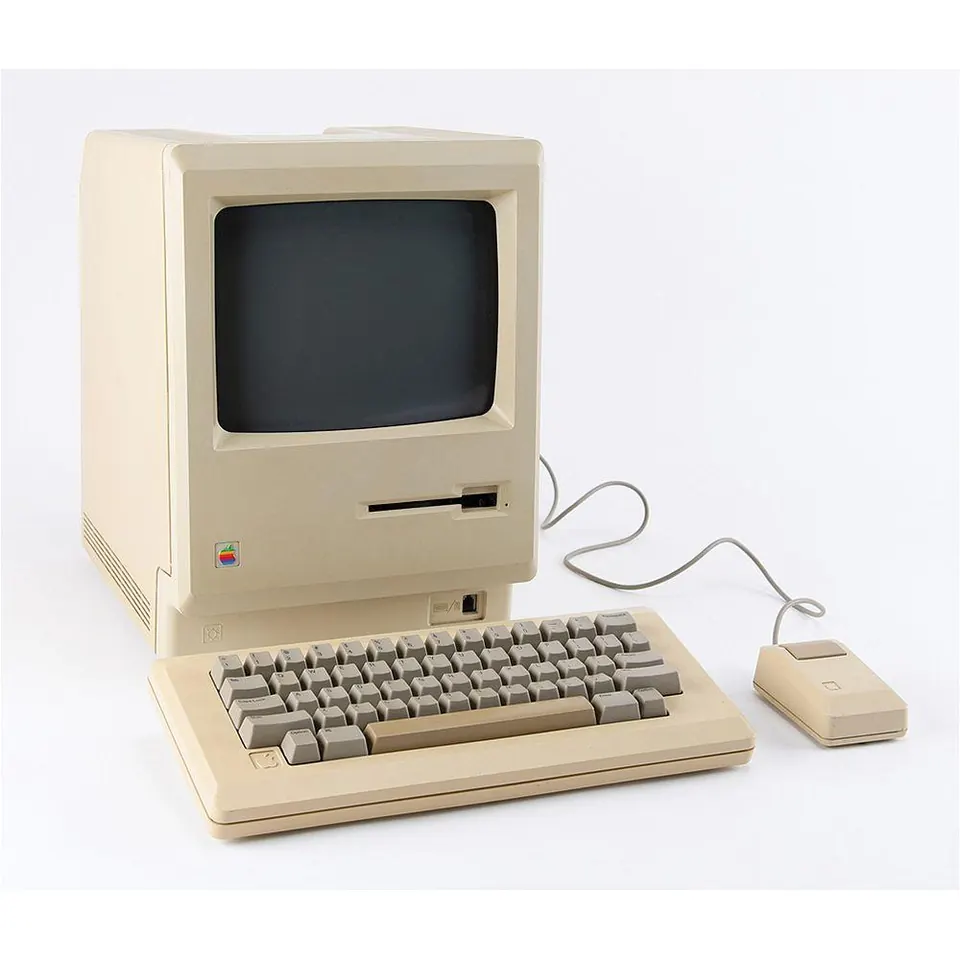
Introduced by Steve Jobs with the iconic 1984 Ridley Scott Super Bowl commercial, the Macintosh replaced confusing command-line prompts with windows, icons, menus, and a desktop mouse.
At $2,495, it was an expensive machine aimed at desktop publishing and design professionals. Its crisp 512x342 black-and-white display gave rise to hyper-detailed pixel art and point-and-click interface games.
Under the hood
- CPU
- Motorola 68000 @ 7.83 MHz with 128 KB to 4 MB RAM
- Sound chip
- 8-bit PWM 4-voice audio DAC built into motherboard
- Graphics
- Integrated 9" crisp monochrome CRT monitor (512 × 342, 1-bit black & white)
- Media
- 3.5" 400 KB / 800 KB / 1.44 MB Floppy Disks & SCSI Hard Drives
What it cost
around a month and a half of an average wage in 1984 · about $7,533 today
| US Macintosh 128k launch price ($2,495 with built-in CRT, keyboard & mouse) | $2,495 (1984) |
|---|---|
| Typical street price | — No verified mass-market street price recorded yet. |
| Units sold | ≈10,000,000 estimate Millions sold across 68k compact and modular Macintoshes. |
Why it mattered
At $2,495, it was an expensive machine aimed at desktop publishing and design professionals. Its crisp 512x342 black-and-white display gave rise to hyper-detailed pixel art and point-and-click interface games.
Emulating it today
| Emulators | Mini vMac, Basilisk II, SheepShaver |
|---|---|
| Setup effort | Fiddly (6.5 on this site's scale) |
| Controls | Many games use a mouse, while setup screens and computer software still expect a keyboard. |
| Runs on a handheld | Yes |
Requires Mac System ROMs (`vMac.ROM`, `MacPlus.rom`) and booting from a bootable System 6 or System 7 floppy/hard disk image (.dsk / .hda). The emulator names above are starting points, not a promise that every title or accessory behaves identically. Computer platforms usually add model selection, disk handling and keyboard setup even when CPU emulation itself is mature.
system firmware or BIOS
Requires a Mac 68k ROM dump (`vMac.ROM` for Mini vMac, `MacII.ROM` for Basilisk II) and a bootable System 6.0.8 or 7.5.5 hard drive disk image.
How many files you need: 1. Start with the firmware for the exact model and region you are emulating; some families need additional revisions for later models.
Where it stands legally: Firmware normally remains copyrighted. The clean route is to extract it from hardware you own unless the rights holder offers a download or licensed package.
Firmware details checked 2026-08. Emulator requirements change — see Libretro documentation for the current list.
Where the software is
TOSEC catalogues computer disks and tapes broadly, including many revisions. It is useful for preservation, while a smaller curated selection is usually easier to play.
Copyright: Commercial software remains copyrighted unless its owner explicitly released or relicensed it. Homebrew, public-domain programs and current reissues should be treated separately from abandoned commercial titles.
This site names preservation projects and explains what they are. It does not link to ROM downloads.
Where to start
- Dark Castle Platform Action
Silicon Beach Software’s ultra-fluid mouse-aiming whip and rock throwing adventure.
- Déjà Vu: A Nightmare Comes True Noir Detective Adventure
The very first MacVenture point-and-click detective game.
- Shadowgate Dark Fantasy Adventure
Atmospheric torch-lit castle dungeon puzzles.
- Shufflepuck Café Air Hockey Simulation
Charming alien bar air hockey played with high-precision mouse tracking.
- SimCity (Classic Mac) City Builder
Will Wright’s original city planner looked most pristine on the high-res Mac desktop.
- The Fool's Errand Visual Puzzle Storybook
Cliff Johnson’s brilliant puzzle tapestry masterpiece.
- Crystal Quest Arcade Arena Action
High-speed mouse-controlled jewel collecting frenzy with hilarious sound effects.
The verdict
The mouse-driven graphical user interface revolution in a compact beige box. Home to iconic monochrome adventures (Dark Castle, Déjà Vu, Shadowgate, SimCity, Shufflepuck Café).
The strongest software can be rewarding, but original controls and setup assumptions may matter more than screenshots suggest.
- Worth it if
- Players curious about apple and the ibm pc and willing to learn how the original machine worked.
- Not for
- Anyone who wants a large, instantly accessible library and no model, firmware or control decisions.
Scored 3/5 for fun today and 4/5 for historical importance. Those two scores decide the label at the top — a machine can matter enormously and still be no fun.
Read more & watch
This page is 50% complete against the facts we try to record for every system. Gaps are shown as gaps.