1972 · Magnavox · US · console
Magnavox Odyssey
The first home console — analog, silent, with overlays you taped to the TV.
Mixed Trivial to run ▶ Watch on YouTube ↗
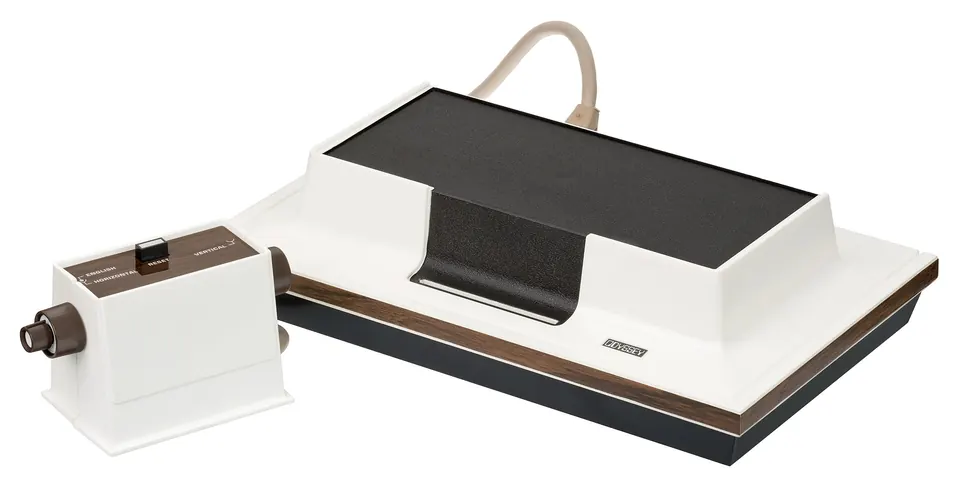
Image: Evan-Amos · Public domain

The console that began home video gaming, released in 1972 from Ralph Baer's designs — an entirely analog machine with no processor, no sound and screen overlays you taped to your television to supply the scenery.
Its Table Tennis game was the one Nolan Bushnell saw at a demonstration shortly before Atari built Pong.
Under the hood
- CPU
- None — discrete transistor logic (approximately 40 transistors and 40 diodes on hand-wired boards); no microprocessor and no memory in any modern sense
- Sound chip
- None — the console produced no audio at all
- Graphics
- Three white dots (two player paddles and a ball) on a black screen; translucent plastic overlays taped to the TV supplied the backgrounds
- Media
- Plug-in jumper 'game cards' that rewired the circuits (28 card variants)
What it cost
about 17% of a month’s pay in 1972 · about $750 today
| US launch list price ($99.95 with 6 game cards & overlays) |
$99.95 (1972)
First commercial home video game console designed by Ralph Baer. |
|---|---|
| Typical street price | — No verified mass-market street price recorded yet. |
| Units sold | ≈350,000 estimate 350,000 units sold between 1972 and 1975. |
What it's worth now
Grail $150–300 loose, $500–1,500+ complete, $3,000+ boxed at auction
The first commercial home console (1972) and, in the source's words, 'the holy grail of console collecting'. Completeness — overlays, game cards, dice and chips — drives the price.
A guide to collectibility, not a valuation — real prices depend on condition, completeness and demand.
Why it mattered
It is the beginning of the whole story — the home video game console whose Table Tennis demo inspired Pong and launched the industry that followed. Nothing in this catalogue happens without it.
Emulating it today
| Emulators | ODYSSEY (libretro), MAME |
|---|---|
| Setup effort | Trivial to run (0.5 on this site's scale) |
| Controls | A standard modern controller covers the ordinary controls, though unusual accessories may need custom mapping. |
| Runs on a handheld | Yes |
The emulator names above are starting points, not a promise that every title or accessory behaves identically. Computer platforms usually add model selection, disk handling and keyboard setup even when CPU emulation itself is mature.
Firmware
This system needs no firmware file. Install an emulator, open a game, and it runs.
How many files you need: none to go and find. No separate firmware file is needed for an ordinary setup.
Firmware details checked 2026-08. Emulator requirements change — see Libretro documentation for the current list.
Where the software is
Preservation catalogues describe verified dumps; they do not grant permission to download commercial software. A curated, correctly matched set is easier to use than an undifferentiated archive.
Copyright: Commercial software remains copyrighted unless its owner explicitly released or relicensed it. Homebrew, public-domain programs and current reissues should be treated separately from abandoned commercial titles.
This site names preservation projects and explains what they are. It does not link to ROM downloads.
Where to start
- Table Tennis 1972 sports
The screen-overlay game that Nolan Bushnell saw before building Pong.
- Haunted House 1972 adventure
- Ski 1972 sports
The verdict
Essential as history; the analog, silent games themselves are barely games by later standards.
Do not expect entertainment — the Odyssey is a landmark to understand, not a console to play.
- Worth it if
- Players curious about the first cartridge consoles and willing to learn how the original machine worked.
- Not for
- Anyone who wants a large, instantly accessible library and no model, firmware or control decisions.
Scored 3/5 for fun today and 3/5 for historical importance. Those two scores decide the label at the top — a machine can matter enormously and still be no fun.
Read more & watch
This page is 50% complete against the facts we try to record for every system. Gaps are shown as gaps.