1979 · Milton Bradley · US · handheld
Milton Bradley Microvision
The first cartridge handheld, with a screen that rarely survived the decade.
A curiosity Trivial to run ▶ Watch on YouTube ↗
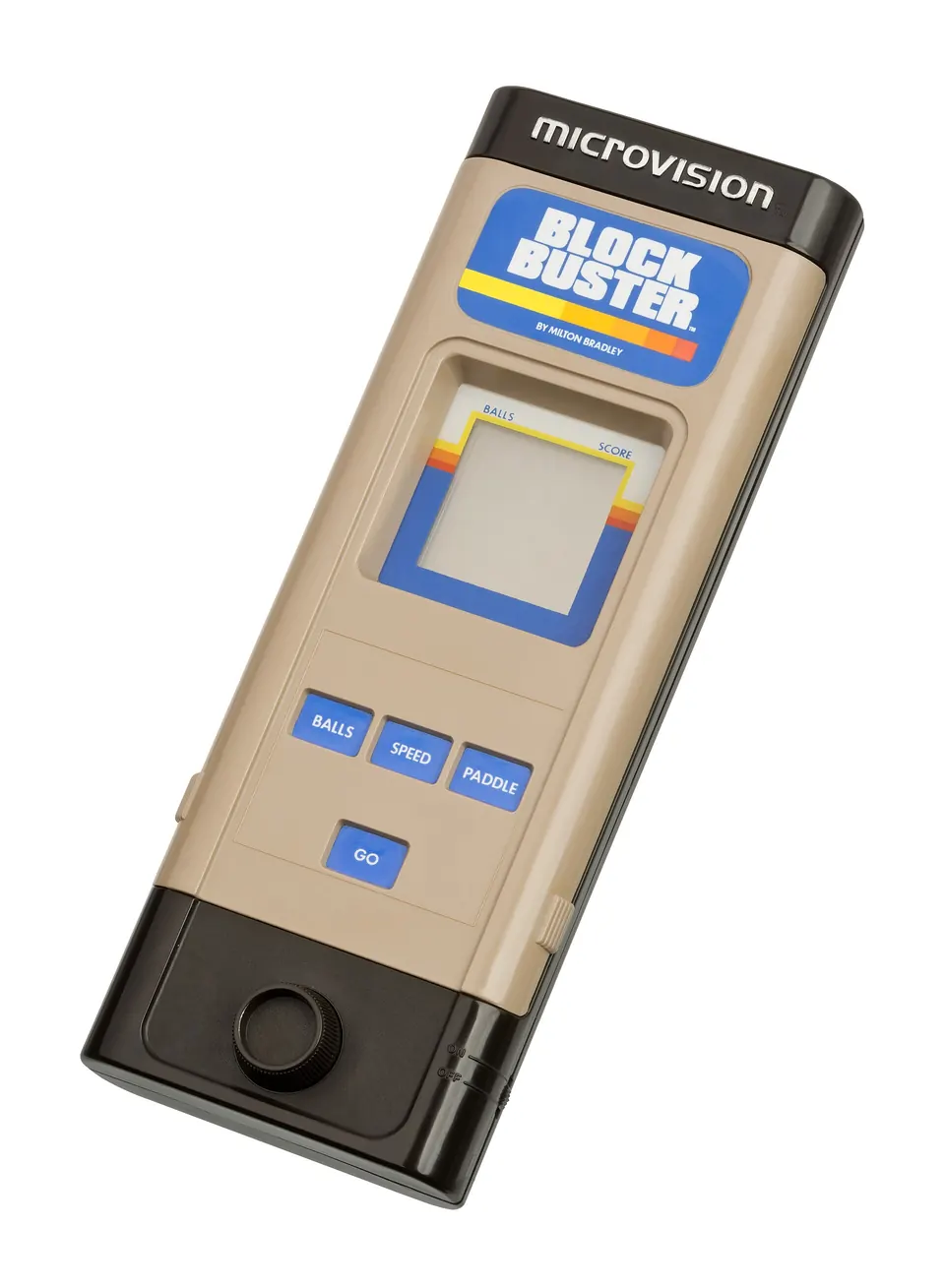
Image: Evan-Amos · Public domain

Milton Bradley's 1979 handheld, the earliest to take interchangeable cartridges — a genuinely pioneering idea housed in hardware whose fragile LCD screens tended to fail with age, so working units are scarce today.
The pack-in Block Buster, a handheld take on Breakout, was the one most people played, sliding a blocky paddle across a screen of just sixteen by sixteen pixels.
What it cost
only about 5% of a month’s pay in 1979 · about $216 today
| US launch list price ($49.99 with Block Buster) |
$49.99 (1979)
First handheld gaming system to use interchangeable cartridges. |
|---|---|
| Typical street price | — No verified mass-market street price recorded yet. |
| Units sold | ≈1,500,000 estimate 1.5 million units sold in its first year. |
Why it mattered
The Microvision was the earliest cartridge handheld, and its fragile screens and tiny library mapped the problems Nintendo would solve a decade later — a pioneer that mostly proved how hard the idea was.
Emulating it today
| Emulators | MAME (microvsn driver) |
|---|---|
| Setup effort | Trivial to run (0 on this site's scale) |
| Controls | A standard modern controller covers the ordinary controls, though unusual accessories may need custom mapping. |
| Runs on a handheld | Yes |
The emulator names above are starting points, not a promise that every title or accessory behaves identically. Computer platforms usually add model selection, disk handling and keyboard setup even when CPU emulation itself is mature.
Firmware
This system needs no firmware file. Install an emulator, open a game, and it runs.
How many files you need: none to go and find. No separate firmware file is needed for an ordinary setup.
Firmware details checked 2026-08. Emulator requirements change — see Libretro documentation for the current list.
Where the software is
Preservation catalogues describe verified dumps; they do not grant permission to download commercial software. A curated, correctly matched set is easier to use than an undifferentiated archive.
Copyright: Commercial software remains copyrighted unless its owner explicitly released or relicensed it. Homebrew, public-domain programs and current reissues should be treated separately from abandoned commercial titles.
This site names preservation projects and explains what they are. It does not link to ROM downloads.
Where to start
- Block Buster 1979 action
The pack-in Breakout for the first cartridge handheld ever made.
- Star Trek: Phaser Strike 1979 shooter
- Bowling 1979 sports
The verdict
Historically important; the games are extremely simple and few.
Its significance is in coming first, not in being good — a short visit for the curious.
- Worth it if
- Players curious about obscure handhelds and willing to learn how the original machine worked.
- Not for
- Anyone who wants a large, instantly accessible library and no model, firmware or control decisions.
Scored 2/5 for fun today and 3/5 for historical importance. Those two scores decide the label at the top — a machine can matter enormously and still be no fun.
Read more & watch
- Emulation General Wiki
- ▶ YouTube: Watch Milton Bradley Microvision retrospectives, demos & reviews ↗
This page is 50% complete against the facts we try to record for every system. Gaps are shown as gaps.