1983 · Microsoft & ASCII (Sony, Panasonic, Toshiba, Yamaha) · Japan · computer
MSX
Conceived by Kazuhiko Nishi of ASCII and Microsoft as a unified Japanese home computer standard.
Essential Easy to run Needs a keyboard ▶ Watch on YouTube ↗
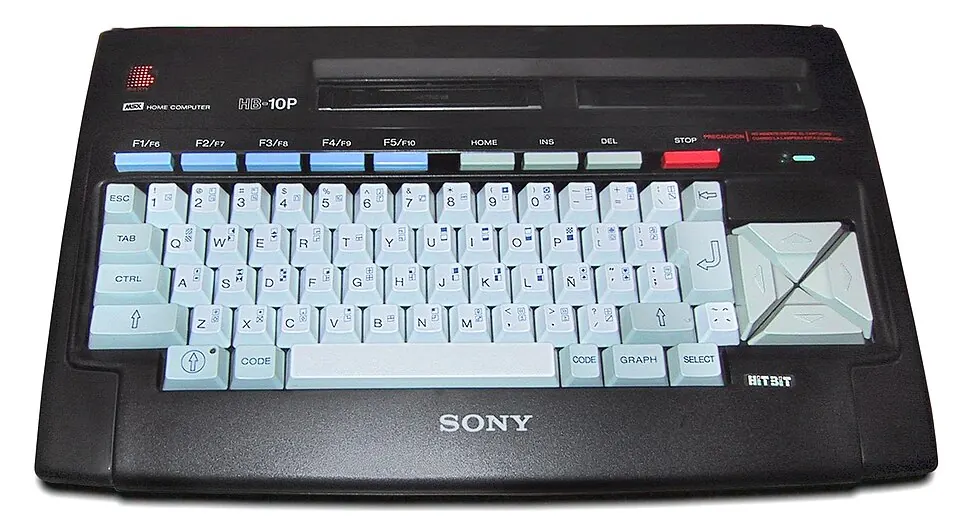
Conceived by Kazuhiko Nishi of ASCII and Microsoft as a unified Japanese home computer standard. Built by giants like Sony, Panasonic, and Yamaha, the MSX was Konami’s primary software showcase.
Hideo Kojima created Metal Gear on the MSX2 because the hardware could not display many moving sprites simultaneously; to compensate, he designed a game where you avoided combat altogether: stealth was born.
Under the hood
- CPU
- Zilog Z80A @ 3.58 MHz (R800 @ 28.6 MHz on Turbo R)
- Sound chip
- General Instrument AY-3-8910 PSG + Konami SCC 5-channel wavetable chip in cartridges + Yamaha YM2413 FM-PAC
- Graphics
- Texas Instruments TMS9918 (MSX1) / Yamaha V9938 (MSX2, 512 colors)
- Media
- MegaROM Cartridges & 3.5" Floppy Disks
What it cost
about 16% of a month’s pay in 1983 · about $659 today
| Japan average launch price (¥49,800 / ~$215 USD) |
¥49,800 (1983)
Universal 8-bit home computing standard led by ASCII and Microsoft. |
|---|---|
| Typical street price | — No verified mass-market street price recorded yet. |
| Units sold | ≈9,000,000 estimate Over 9 million MSX systems sold worldwide (Japan, Europe, South Korea, South America). |
Why it mattered
Hideo Kojima created Metal Gear on the MSX2 because the hardware could not display many moving sprites simultaneously; to compensate, he designed a game where you avoided combat altogether: stealth was born.
Emulating it today
| Emulators | openMSX, fMSX (libretro), blueMSX |
|---|---|
| Setup effort | Easy to run (2 on this site's scale) |
| Controls | Many games use a mouse, while setup screens and computer software still expect a keyboard. |
| Runs on a handheld | Yes |
Uses BlueMSX or openMSX cores. Set machine type to MSX2+ or MSX Turbo R for enhanced colors and SCC audio support. The emulator names above are starting points, not a promise that every title or accessory behaves identically. Computer platforms usually add model selection, disk handling and keyboard setup even when CPU emulation itself is mature.
MSX BIOS & BASIC ROM (MSX.ROM)
MSX machines run a standardized system BIOS and MSX-BASIC burned into motherboard ROM chips. While open-source replacements like C-BIOS allow many cartridge games to boot without commercial ROMs, full compatibility—especially for tape software, disk loading, and MSX-BASIC type-ins—requires the original MSX BIOS ROM dump.
How many files you need: 1. One primary file: MSX.ROM (32 KB BIOS and BASIC). Disk setups also require a DISK.ROM image.
Where it stands legally: Original MSX BIOS ROMs are copyrighted by Microsoft and ASCII Corporation (or respective hardware vendors like Panasonic and Sony). Open-source C-BIOS is free but has limited compatibility with disk games.
Firmware details checked 2026-08. Emulator requirements change — see openMSX Documentation for the current list.
Where the software is
TOSEC catalogues computer disks and tapes broadly, including many revisions. It is useful for preservation, while a smaller curated selection is usually easier to play.
Copyright: Commercial software remains copyrighted unless its owner explicitly released or relicensed it. Homebrew, public-domain programs and current reissues should be treated separately from abandoned commercial titles.
This site names preservation projects and explains what they are. It does not link to ROM downloads.
Where to start
- Metal Gear Stealth Action
Hideo Kojima’s original breakthrough stealth action masterpiece.
- Metal Gear 2: Solid Snake Stealth Action
Way ahead of its time with radar, crawl spaces, and deep cinematic plot.
- Vampire Killer Action Platformer / Adventure
The alternate non-linear version of the original Castlevania with item keys.
- Snatcher (MSX2) Cyberpunk Adventure
Hideo Kojima’s Blade Runner-inspired graphic novel adventure.
- Nemesis (Gradius) 1 & 2 Shoot 'em up
Packed with Konami SCC wavetable audio chip delivering arcade-grade music.
- Space Manbow Shoot 'em up
One of the most technically impressive horizontal shmups on 8-bit hardware.
- Penguin Adventure Action Adventure
Hideo Kojima’s first credited game design project at Konami.
- The Maze of Galious Action RPG / Metroidvania
Castle exploration with Greek mythology gods and dual protagonist switching.
The verdict
The Japanese home computer standard that birthed Metal Gear, Castlevania (Vampire Killer), Bomberman, and Snatcher. Unbelievable Konami cartridge library with SCC custom sound chips.
The strongest software can be rewarding, but original controls and setup assumptions may matter more than screenshots suggest.
- Worth it if
- Players curious about sharp, fujitsu and msx and willing to learn how the original machine worked.
- Not for
- Anyone who wants a large, instantly accessible library and no model, firmware or control decisions.
Scored 4/5 for fun today and 5/5 for historical importance. Those two scores decide the label at the top — a machine can matter enormously and still be no fun.
Read more & watch
This page is 50% complete against the facts we try to record for every system. Gaps are shown as gaps.