1985 · MSX2 · Japan · computer
MSX2
The upgraded MSX standard, and Konami's canvas for Metal Gear 2.
Mixed Easy to run Needs a keyboard ▶ Watch on YouTube ↗
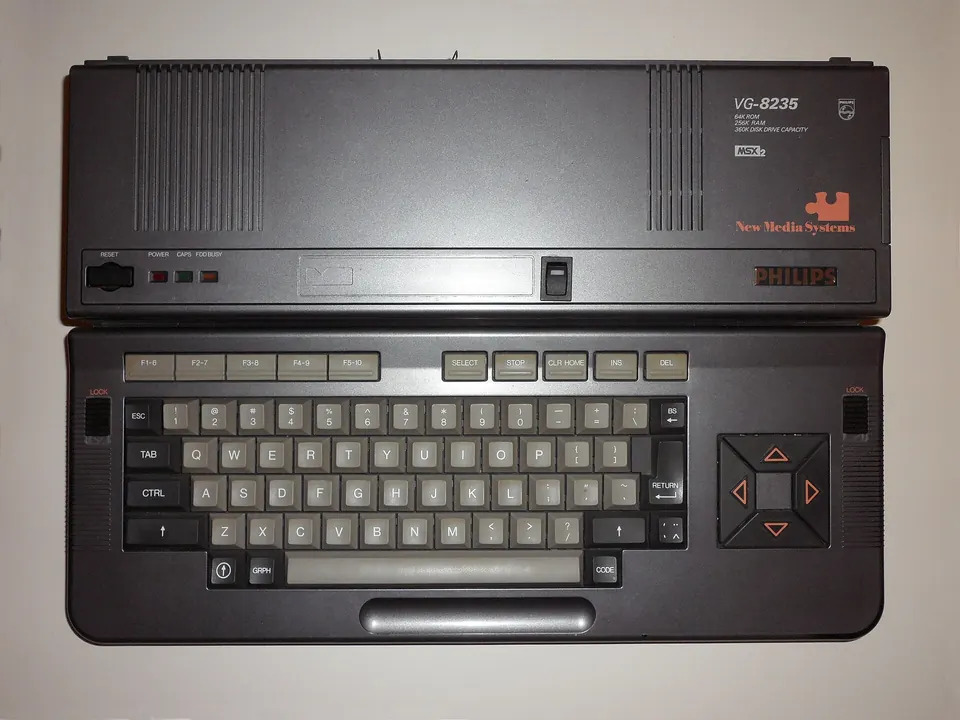
Image: Juanjo Marin · CC BY-SA 2.0

The 1985 upgrade to the MSX standard, with far richer graphics, and a machine that mattered most in Japan, where Konami made it a home for some of its most ambitious 8-bit work.
Metal Gear 2: Solid Snake ran here — Kojima's real blueprint for the series, years before the PlayStation caught up with it.
Under the hood
- CPU
- Zilog Z80A @ 3.58 MHz
- Sound chip
- General Instrument AY-3-8910 PSG (+ optional Konami SCC / Yamaha YM2413 FM-PAC in cartridges)
- Graphics
- Yamaha V9938 — up to 512 colours
What it cost
about a quarter of a month’s pay in 1985 · about $855 today
| Japan average launch price (¥69,800 / ~$295 USD) |
¥69,800 (1985)
Yamaha V9938 video processor delivering 256 colors; birthplace of Konami classics like Metal Gear and Snatcher. |
|---|---|
| Typical street price | — No verified mass-market street price recorded yet. |
| Units sold | ≈9,000,000 estimate Included in 9 million worldwide MSX family total. |
Why it mattered
The MSX2 was where Konami did some of its most ambitious 8-bit work, including the Metal Gear that shaped a franchise — a reminder that Japan's home-computer standard was a serious games platform.
Emulating it today
| Emulators | openMSX, blueMSX (libretro) |
|---|---|
| Setup effort | Easy to run (2.5 on this site's scale) |
| Controls | This is a computer-like platform: games may use a joystick or pad, but launching and configuring software often needs a keyboard. |
| Runs on a handheld | Yes |
The emulator names above are starting points, not a promise that every title or accessory behaves identically. Computer platforms usually add model selection, disk handling and keyboard setup even when CPU emulation itself is mature.
MSX2 Main BIOS & Sub-ROM (MSX2.ROM, MSX2SUB.ROM)
MSX2 computers require both the 32 KB Main BIOS/BASIC ROM (MSX2.ROM) and the 16 KB Sub-ROM (MSX2SUB.ROM) containing V9938 video routines, character generator fonts, and palette tables. Disk-based games also require a floppy disk controller ROM.
How many files you need: 2. Two core files: MSX2.ROM and MSX2SUB.ROM. Japanese models and disk games also use KANJI.ROM and DISK.ROM.
Where it stands legally: MSX2 BIOS and Sub-ROMs are copyrighted by Microsoft / ASCII / hardware manufacturers and must be dumped from original MSX2 machines.
Firmware details checked 2026-08. Emulator requirements change — see openMSX Setup & ROM Guide for the current list.
Where the software is
TOSEC catalogues computer disks and tapes broadly, including many revisions. It is useful for preservation, while a smaller curated selection is usually easier to play.
Copyright: Commercial software remains copyrighted unless its owner explicitly released or relicensed it. Homebrew, public-domain programs and current reissues should be treated separately from abandoned commercial titles.
This site names preservation projects and explains what they are. It does not link to ROM downloads.
Where to start
- Metal Gear 2: Solid Snake 1990 stealth
Kojima's real blueprint for the series, years before the PlayStation caught up.
- SD Snatcher 1990 RPG
- Nemesis 2 1987 shoot 'em up
- Space Manbow 1989 shoot 'em up
- Aleste 1988 shoot 'em up
- Ys II 1988 action RPG
The verdict
Worth it for the Konami catalogue and the original Metal Gear games; a strong library, much of it in Japanese.
The best of it is Japanese and can need patience to navigate — but the highlights reward the effort.
- Worth it if
- Players curious about sharp, fujitsu and msx and willing to learn how the original machine worked.
- Not for
- Anyone who wants a large, instantly accessible library and no model, firmware or control decisions.
Scored 3/5 for fun today and 3/5 for historical importance. Those two scores decide the label at the top — a machine can matter enormously and still be no fun.
Read more & watch
This page is 50% complete against the facts we try to record for every system. Gaps are shown as gaps.