1983 · Nintendo · Japan · console
Nintendo Entertainment System
Following the 1983 crash of the US video game market, Nintendo engineered the Famicom/NES with the "Nintendo Seal of Quality" and a front-loading VCR-like…
Also sold as Famicom
Essential Trivial to run ▶ Watch on YouTube ↗
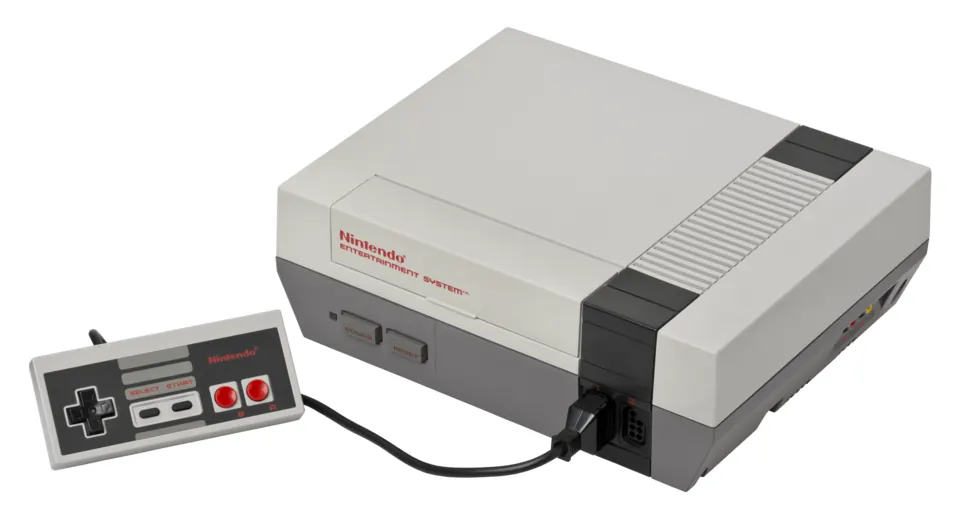
Following the 1983 crash of the US video game market, Nintendo engineered the Famicom/NES with the "Nintendo Seal of Quality" and a front-loading VCR-like design. It redefined game design, scrolling physics, and console storytelling.
Shigeru Miyamoto and Takashi Tezuka created Super Mario Bros. and The Legend of Zelda, proving that games were not just high-score arcade tests, but vast global of mystery and adventure.
Under the hood
- CPU
- Ricoh 2A03 (6502 core) @ 1.79 MHz (NTSC) / 2A07 @ 1.66 MHz (PAL)
- Sound chip
- Built-in APU (2 square channels, 1 triangle, 1 noise, 1 DPCM sample channel)
- Graphics
- Ricoh 2C02 PPU, 256 × 240, 54-color palette, 64 sprites (Enhanced by MMC memory mappers)
- Media
- 72-pin ROM Cartridges (Famicom 60-pin) & FDS Floppy Disks
Hardware revisions
| Model | Years | What changed |
|---|---|---|
| NES-001NES (front-loader, original) | 1985 (test) / 1986 (wide US launch) | Front-loading ZIF cartridge slot, VCS-style two-tone gray design; Known issue: ZIF connector pins wear from repeated cartridge insertion, causing the classic 'blinking red light' failure to boot |
| NES-101NES 'Top Loader' | Oct 1993 | Top-loading cartridge slot fixes the ZIF reliability problem; Known issue: AV-output only — no coaxial RF output option |
What it cost
only about 7% of a month’s pay in 1987 · about $248 today
| US Deluxe Set launch price ($179.99 with R.O.B., Zapper & Gyromite) |
$179.99 (1985)
about 14% of a month’s pay · about $525 in today's money |
|---|---|
| Control Deck only package ($89.99) | $89.99 (1987) |
| Famicom launch price (¥14,800) | ¥14,800 |
| Units sold | 61,910,000 61.91 million units worldwide. |
What it's worth now
Moderate $60–100 front-loader, $120–200 top-loader, $200–400+ boxed
A refurbished 72-pin connector is the detail that separates a good front-loader buy from the classic blinking-light frustration.
A guide to collectibility, not a valuation — real prices depend on condition, completeness and demand.
Why it mattered
Shigeru Miyamoto and Takashi Tezuka created Super Mario Bros. and The Legend of Zelda, proving that games were not just high-score arcade tests, but vast global of mystery and adventure.
Emulating it today
| Emulators | Mesen, Nestopia UE, FCEUmm |
|---|---|
| Setup effort | Trivial to run (0 on this site's scale) |
| Controls | A standard modern controller covers the ordinary controls, though unusual accessories may need custom mapping. |
| Runs on a handheld | Yes |
Flawless plug-and-play emulation on Mesen, FCEUmm, and Nestopia cores with zero configuration needed. The emulator names above are starting points, not a promise that every title or accessory behaves identically. Computer platforms usually add model selection, disk handling and keyboard setup even when CPU emulation itself is mature.
Firmware
This system needs no firmware file. Install an emulator, open a game, and it runs.
How many files you need: none to go and find. No separate firmware file is needed for an ordinary setup.
Firmware details checked 2026-08. Emulator requirements change — see Libretro documentation for the current list.
Where the software is
Preservation catalogues describe verified dumps; they do not grant permission to download commercial software. A curated, correctly matched set is easier to use than an undifferentiated archive.
Copyright: Commercial software remains copyrighted unless its owner explicitly released or relicensed it. Homebrew, public-domain programs and current reissues should be treated separately from abandoned commercial titles.
This site names preservation projects and explains what they are. It does not link to ROM downloads.
Where to start
- Super Mario Bros. 3 Platformer
The ultimate 8-bit platformer with 8 diverse worlds, world maps, and the Tanooki suit.
- The Legend of Zelda Action Adventure
The gold cartridge that introduced battery backup saving and open-world exploration.
- Mega Man 2 Action Platformer
Takashi Tateishi’s iconic soundtrack and flawless 8-robot boss weapon cycle.
- Castlevania III: Dracula's Curse Action Platformer
Branching paths and 4 playable characters with the VRC6 Japanese expanded audio chip.
- Metroid Action Adventure / Sci-Fi
Isolated maze atmosphere on Planet Zebes with the legendary Samus Aran reveal.
- Contra Run & Gun Co-op
The quintessential 2-player co-op action game and home of the Konami Code.
- Punch-Out!! (Mike Tyson) Pattern Reflex Action
Iconic character patterns and high-intensity boxing timing.
- Kirby's Adventure Platformer
Masahiro Sakurai’s visual masterpiece pushing the NES PPU to its absolute limit.
- Ninja Gaiden Action Platformer
Pioneered full-motion cinematic cutscenes and blistering ninja acrobatics.
- DuckTales Platformer
Capcom’s pogo-jumping Disney classic with the legendary Moon Theme.
- Battletoads 1991 Beat 'em up
- Donkey Kong Platformer
- Duck Hunt 1984 Light-gun shooter
The verdict
The titan that resurrected the video game industry. Super Mario Bros. 3, The Legend of Zelda, Mega Man 2, Metroid, Castlevania III—an endless catalog of timeless 8-bit perfection.
The strongest software can be rewarding, but original controls and setup assumptions may matter more than screenshots suggest.
- Worth it if
- Players curious about nintendo home consoles, 8- and 16-bit and willing to learn how the original machine worked.
- Not for
- Anyone who wants a large, instantly accessible library and no model, firmware or control decisions.
Scored 5/5 for fun today and 5/5 for historical importance. Those two scores decide the label at the top — a machine can matter enormously and still be no fun.
Read more & watch
- Emulation General Wiki
- ▶ YouTube: Watch Nintendo Entertainment System retrospectives, demos & reviews ↗
This page is 75% complete against the facts we try to record for every system. Gaps are shown as gaps.