2011 · Nintendo · Japan · handheld
Nintendo 3DS
Glasses-free 3D, a rough launch, and one of the deepest handheld libraries ever.
Mixed Some setup ▶ Watch on YouTube ↗
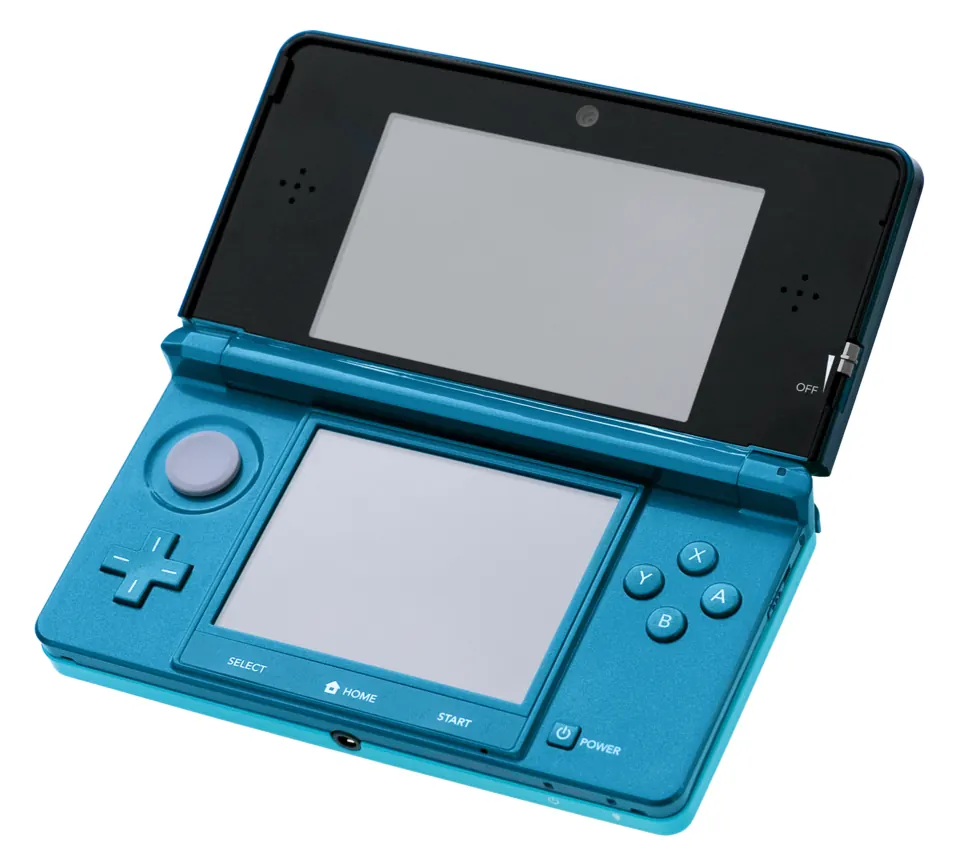
Nintendo's 2011 handheld, whose gimmick was glasses-free stereoscopic 3D. A disastrous launch forced an emergency price cut, after which it built one of the deepest libraries of any portable.
Super Mario 3D Land and Fire Emblem: Awakening — the game that saved that series — were among its peaks, alongside a superb pocket-sized Zelda.
Under the hood
Hardware revisions
| Model | Years | What changed |
|---|---|---|
| CTR-001Nintendo 3DS (original) | Feb 2011 | Autostereoscopic (glasses-free) 3D 3.53in screen, single Circle Pad; Known issue: Circle Pad drift reported over time |
| SPR-001Nintendo 3DS XL | Jul 2012 | Screens roughly 90% larger than the original 3DS at the same resolution (lower pixel density); Known issue: Shares the Circle Pad drift risk of the original 3DS |
| FTR-001Nintendo 2DS | Oct 2013 | 3D functionality removed entirely; slate (non-clamshell) form factor, budget-targeted; Known issue: No hinge — a different failure profile than the clamshell 3DS models |
| KTR-001New Nintendo 3DS | Oct 2014 | Adds a C-Stick and ZL/ZR buttons, built-in NFC/amiibo support, interchangeable faceplates, faster CPU; Known issue: C-Stick (a nub, not a true analog stick) wear/responsiveness complaints |
| RED-001New Nintendo 3DS XL | Oct 2014 | Same New-3DS upgrades as KTR-001 in the larger XL screen size, no interchangeable faceplates; Known issue: Same C-Stick concerns as KTR-001 |
| JAN-001New Nintendo 2DS XL | Jul 2017 | Combines New-3DS internals (C-Stick, NFC, ZL/ZR) with a clamshell form factor and no 3D display |
What it cost
only about 5% of a month’s pay in 2011 · about $237 today
| US launch list price ($249.99) |
$249.99 (2011)
only about 7% of a month’s pay · about $349 in today's money |
|---|---|
| Famous Ambassador Program price cut to $169.99 |
$169.99 (2011)
Early adopters received 20 free NES and GBA Virtual Console games. |
| Units sold | 75,940,000 75.94 million units sold worldwide. |
Why it mattered
The 3DS proved a dedicated handheld could still thrive in the smartphone age, building one of the deepest portable libraries ever after surviving one of gaming's worst launches.
Emulating it today
| Emulators | Citra, Lime3DS, PabloMK7 Citra |
|---|---|
| Setup effort | Some setup (4.5 on this site's scale) |
| Controls | A standard modern controller covers the ordinary controls, though unusual accessories may need custom mapping. |
| Runs on a handheld | Yes |
The emulator names above are starting points, not a promise that every title or accessory behaves identically. Computer platforms usually add model selection, disk handling and keyboard setup even when CPU emulation itself is mature.
3DS AES Decryption Keys & System Firmware (aes_keys.txt)
Citra, Lime3DS, and PabloMK7's Citra emulate the 3DS OS using high-level emulation for decrypted .3ds/.cci games. Encrypted retail eShop .cia dumps, DLC, system fonts, and games requiring Mii data or system applets require AES encryption keys (aes_keys.txt) and dumped system archives.
How many files you need: 1. One key file (aes_keys.txt) for encrypted games, or dumped system archives for system applet support.
Where it stands legally: Keys and system firmware are proprietary Nintendo software and must be dumped from a hacked 3DS console using GodMode9.
Firmware details checked 2026-08. Emulator requirements change — see Citra / Lime3DS Documentation for the current list.
Where the software is
Preservation catalogues describe verified dumps; they do not grant permission to download commercial software. A curated, correctly matched set is easier to use than an undifferentiated archive.
Copyright: Commercial software remains copyrighted unless its owner explicitly released or relicensed it. Homebrew, public-domain programs and current reissues should be treated separately from abandoned commercial titles.
This site names preservation projects and explains what they are. It does not link to ROM downloads.
Where to start
- The Legend of Zelda: A Link Between Worlds 2013 action adventure
- Super Mario 3D Land 2011 platformer
- Fire Emblem: Awakening 2012 strategy RPG
The game that saved the series from cancellation.
- Pokémon X and Y 2013 RPG
- Mario Kart 7 2011 racing
- Animal Crossing: New Leaf 2012 life sim
- Monster Hunter 4 Ultimate 2014 action RPG
The verdict
Essential. A vast library led by Fire Emblem: Awakening and a top-tier pocket Zelda; emulation is maturing steadily.
The 3D and dual screens still take some setup, and the newest games can be demanding to run.
- Worth it if
- Players curious about nintendo handhelds and willing to learn how the original machine worked.
- Not for
- Anyone who wants a large, instantly accessible library and no model, firmware or control decisions.
Scored 3/5 for fun today and 3/5 for historical importance. Those two scores decide the label at the top — a machine can matter enormously and still be no fun.
Read more & watch
This page is 75% complete against the facts we try to record for every system. Gaps are shown as gaps.