1996 · Nintendo · Japan · console
Nintendo 64
Co-engineered with Silicon Graphics (SGI), the Nintendo 64 wrote the grammar of 3D gaming.
Essential Trivial to run ▶ Watch on YouTube ↗
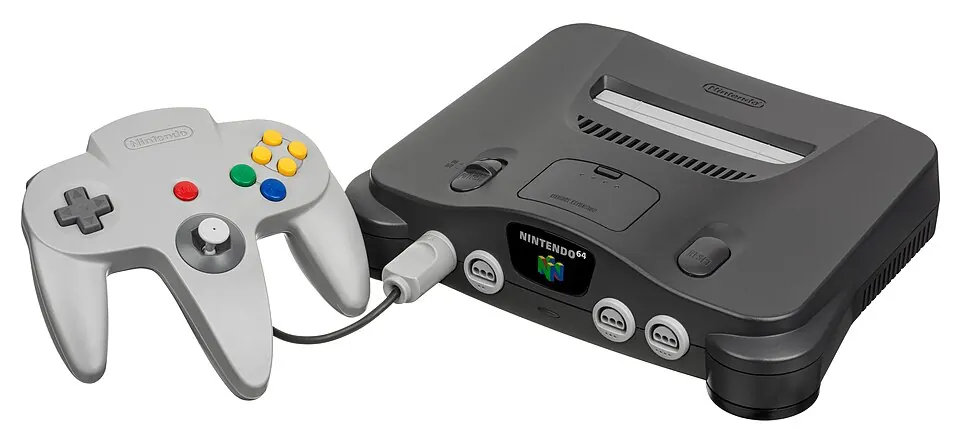
Co-engineered with Silicon Graphics (SGI), the Nintendo 64 wrote the grammar of 3D gaming. Shigeru Miyamoto’s analog thumbstick and dynamic camera in Super Mario 64 and Z-targeting lock-on in Ocarina of Time established how 3D games are played to this day.
While cartridges limited storage space compared to CD-ROMs, they eliminated load times and made split-screen 4-player party multiplayer (GoldenEye, Smash Bros, Mario Kart 64) an unforgettable living-room tradition.
Under the hood
- CPU
- NEC VR4300 (64-bit MIPS RISC) @ 93.75 MHz with 4 MB RAM (Expandable to 8 MB with Expansion Pak)
- Sound chip
- Reality Coprocessor (RCP / RSP) audio microcode driving software sample synthesis (No dedicated sound chip)
- Graphics
- Silicon Graphics (SGI) Reality Display Processor (RDP), 320 × 240, hardware bilinear filtering, perspective correction, anti-aliasing
- Media
- ROM Cartridges (8 MB to 64 MB) & 4 built-in controller ports
Hardware revisions
| Model | Years | What changed |
|---|---|---|
| NUS-001Nintendo 64 | Jun 1996 (JP) / Sept 1996 (NA) / Mar 1997 (EU/AU) | Original release, no prior hardware revision |
What it cost
only about 6% of a month’s pay in 1998 · about $250 today
| US launch list price ($199.99) |
$199.99 (1996)
only about 9% of a month’s pay · about $400 in today's money |
|---|---|
| Mass-market street price ($129.99) |
$129.99 (1998)
Price reduced in 1998 as competition with PlayStation intensified. |
| Japan launch price (¥25,000) | ¥25,000 |
| Units sold | 32,930,000 32.93 million units worldwide (Nintendo official consolidated figure). |
What it's worth now
Moderate $60–100 working, with one controller
Funtastic colour variants command $100–200+ premiums; original controllers with worn analog sticks are the common weak point.
A guide to collectibility, not a valuation — real prices depend on condition, completeness and demand.
Why it mattered
While cartridges limited storage space compared to CD-ROMs, they eliminated load times and made split-screen 4-player party multiplayer (GoldenEye, Smash Bros, Mario Kart 64) an unforgettable living-room tradition.
Emulating it today
| Emulators | Rosalie's Mupen GUI (RMG), Simple64, ares, Mupen64Plus-Next (libretro) |
|---|---|
| Setup effort | Trivial to run (1 on this site's scale) |
| Controls | A standard modern controller covers the ordinary controls, though unusual accessories may need custom mapping. |
| Runs on a handheld | Yes |
SimpleSetup using mupen64plus-next core with ParaLLEl RDP / GLideN64 video plugins. Delivers crisp upscaled 3D polygons with authentic anti-aliasing. The emulator names above are starting points, not a promise that every title or accessory behaves identically. Computer platforms usually add model selection, disk handling and keyboard setup even when CPU emulation itself is mature.
Firmware
This system needs no firmware file. Install an emulator, open a game, and it runs.
How many files you need: none to go and find. No separate firmware file is needed for an ordinary setup.
Firmware details checked 2026-08. Emulator requirements change — see Libretro documentation for the current list.
Where the software is
Preservation catalogues describe verified dumps; they do not grant permission to download commercial software. A curated, correctly matched set is easier to use than an undifferentiated archive.
Copyright: Commercial software remains copyrighted unless its owner explicitly released or relicensed it. Homebrew, public-domain programs and current reissues should be treated separately from abandoned commercial titles.
This site names preservation projects and explains what they are. It does not link to ROM downloads.
Where to start
- The Legend of Zelda: Ocarina of Time Action Adventure
Regularly ranked the greatest video game of all time; invented Z-targeting and day/night cycle pacing.
- Super Mario 64 3D Platformer
The Rosetta Stone of 3D gaming; invented analog camera control and 3D momentum.
- GoldenEye 007 First-Person Shooter
Rare’s legendary stealth/shooter campaign and 4-player split-screen deathmatch phenomenon.
- The Legend of Zelda: Majora's Mask Action Adventure
A dark, haunting 3-day time-loop masterpiece requiring the 8MB Expansion Pak.
- Banjo-Kazooie 3D Platformer
Rare’s vibrant collect-a-thon perfection with Grant Kirkhope’s dynamic branching soundtrack.
- Super Smash Bros. Platform Fighter
Masahiro Sakurai’s 4-player Nintendo all-star brawler that spawned a competitive legacy.
- Mario Kart 64 Kart Racing
4-player split-screen battle mode and Blue Shell mayhem.
- Perfect Dark First-Person Shooter
Rare’s technical tour de force with customizable multiplayer combat bots and thermal goggles.
- Paper Mario RPG
Charming pop-up storybook RPG with active timing battle commands.
- F-Zero X 3D Futuristic Racing
Rock-solid 60fps supersonic racing with 30 anti-gravity hovering machines simultaneously.
- Diddy Kong Racing 1997 Kart racing game
- Donkey Kong 64 1999 Platformer
- Banjo-Tooie 2000 Action-adventure game
- Bomberman 64 1997 Action-adventure game
The verdict
Invented 3D camera control, analog stick navigation, and 4-player split-screen multiplayer. Super Mario 64, Ocarina of Time, GoldenEye 007, and Super Smash Bros. are foundational cornerstones of…
The strongest software can be rewarding, but original controls and setup assumptions may matter more than screenshots suggest.
- Worth it if
- Players curious about nintendo home consoles, 8- and 16-bit and willing to learn how the original machine worked.
- Not for
- Anyone who wants a large, instantly accessible library and no model, firmware or control decisions.
Scored 5/5 for fun today and 5/5 for historical importance. Those two scores decide the label at the top — a machine can matter enormously and still be no fun.
Read more & watch
This page is 75% complete against the facts we try to record for every system. Gaps are shown as gaps.