1977 · RCA · US · console
RCA Studio II
One of the first consoles you could buy cartridges for, and obsolete within eight months of going on sale.
Museum piece Trivial to run ▶ Watch on YouTube ↗
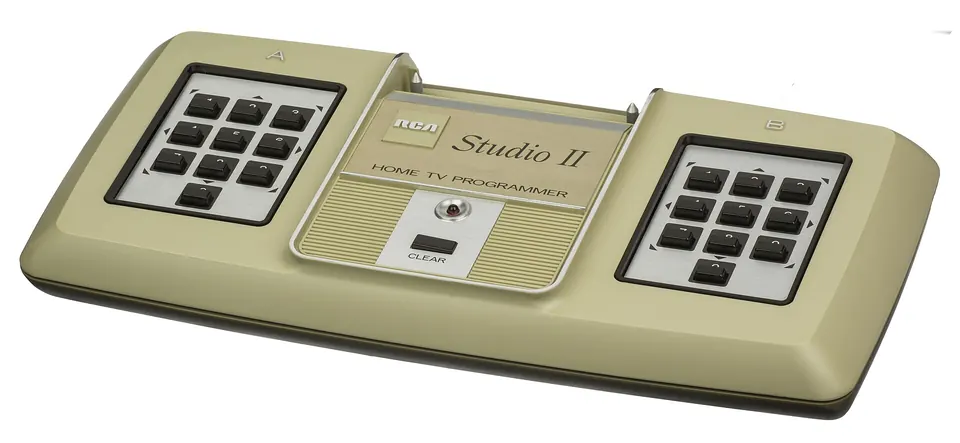
Image: Evan-Amos · Public domain

RCA's attempt at a programmable home console, launched in January 1977. It was black and white, ran at 64×32 pixels, made one kind of beep, and instead of joysticks had two ten-key pads built into the front of the box. Five games came built in; eleven more were sold on cartridge.
It was not a bad execution of its idea. The problem was the calendar. The Atari 2600 arrived in September 1977 with colour, sound and joysticks you could hold, and the comparison was immediate and fatal. RCA announced the Studio II's discontinuation in February 1978 after a poor Christmas.
What survives is a clean illustration of how fast the ground moved in 1977 — this was a 1975 machine that happened to ship two years late, into a market that had just been redefined.
Under the hood
- CPU
- RCA CDP1802 (COSMAC) — ~1.78 MHz
- Sound chip
- Single-tone beeper
- Graphics
- Monochrome, 64×32 resolution
- Memory
- 512 bytes
- Media
- ROM cartridge
What it cost
about 18% of a month’s pay in 1977 · about $776 today
| US launch list price ($149.95 with 5 built-in games) |
$149.95 (1977)
Built on the RCA CDP1802 COSMAC microprocessor with numeric keypad controllers. |
|---|---|
| Typical street price | — The console was cleared out through 1978 after RCA cancelled it, but no reliable record of the discounted price survives. |
| Units sold | ≈60,000 estimate Estimated 50,000–60,000 units before cancellation. |
Five games were built into the console, so this was a complete purchase on day one — no extra cartridge required to have something to play.
What else cost that kind of money
- 19-inch colour television 1983 31%
Each bar is that item's price as a share of one month's average wage in its year. Benchmark prices are reconstructions, not transcribed catalogue line items. They were assembled from period trade press and catalogue reporting and every one is marked verified:false until it is checked against a dated scan. They are shown to give a sense of scale, not as precise figures. The wage series they are divided by, by contrast, is official SSA data.
Why it mattered
It is one of the earliest cartridge-based consoles, and the clearest example of a product killed not by its own faults but by the pace of the industry around it. Its processor, the CDP1802, went on to a long second life in spacecraft, where being radiation-hardened mattered more than being fast.
Emulating it today
| Emulators | MAME (studio2 driver) |
|---|---|
| Setup effort | Trivial to run (0.5 on this site's scale) |
| Controls | Two ten-key pads moulded into the front of the console itself, so both players sat shoulder to shoulder at the box. There is no joystick, and there is no arrangement of a modern controller that makes this feel right. |
| Runs on a handheld | Yes |
The hardware is simple enough that emulation is essentially exact. All the friction is on your side. Most frontends have no Studio II platform at all, so you launch it through MAME as a machine rather than as a console, and then you map a ten-key pad onto a controller that does not have ten keys. Worth knowing before you assume something is broken: on boot the machine shows a white block and scattered garbage until you press the CLEAR key, which is F3 in MAME. That is normal behaviour, not a bad dump.
European MPT-02 cartridges run fine on the same MAME driver.
system ROM
The Studio II kept its built-in games and its operating code on chips soldered to the motherboard. In MAME these arrive as part of the machine's own ROM set rather than as a separate BIOS file you go looking for — so if MAME can start the machine at all, you already have what you need. There is nothing to place in a BIOS folder.
How many files you need: none to go and find. Nothing separate to find. The system ROM travels inside MAME's machine set for this driver.
Where it stands legally: The system ROM is still RCA's property in principle, and there is no commercial re-release. In practice it is preserved as part of MAME's machine sets rather than distributed as a standalone BIOS file.
Firmware details checked 2026-08. Emulator requirements change — see MAME — official site and documentation for the current list.
Where the software is
MAME maintains software lists — catalogues of verified cartridge dumps tied to a specific machine. For a system with eleven commercial cartridges, the MAME software list is effectively the complete surviving record of what was ever released.
Copyright: The cartridges remain RCA's copyright in principle, though the company has shown no interest in them for nearly fifty years and there has never been a re-release. This is abandoned commercial software rather than free software, and it is worth being clear about the difference.
This site names preservation projects and explains what they are. It does not link to ROM downloads.
Where to start
- Spacewar shooter
The one people single out, and mostly for historical reasons.
- Bowling sports
- Baseball sports
- Blackjack cards
One of the five built-in games.
- TV Schoolhouse I educational
- Tennis / Squash Sports
Built-in Pong clone.
- Gunfighter / Moonship Action
Two-in-one cartridge.
The verdict
Worth twenty minutes for the history, and not one minute more for the games.
The entire library is eleven cartridges and takes almost no space, so there is no real cost to having it around even if you never play it twice.
- Worth it if
- People working through the history of cartridge consoles in order, and anyone curious about what the Atari 2600 was competing against.
- Not for
- Anyone looking for something to actually play.
Scored 1/5 for fun today and 4/5 for historical importance. Those two scores decide the label at the top — a machine can matter enormously and still be no fun.
The rest of the family
A rebadged relative was sold in Europe as the Hanimex and Sheen 1292-series machines, but those are a different chipset lineage and are not covered here.
Read more & watch
- RCA Studio II — Wikipedia
- IEEE Spectrum — Chip Hall of Fame: RCA CDP1802
- ▶ YouTube: Watch RCA Studio II retrospectives, demos & reviews ↗
This page is 75% complete against the facts we try to record for every system. Gaps are shown as gaps.