1990 · Nintendo · Japan · console
Super Nintendo
The pinnacle of 16-bit gaming craftsmanship.
Also sold as Super Famicom
Essential Trivial to run ▶ Watch on YouTube ↗
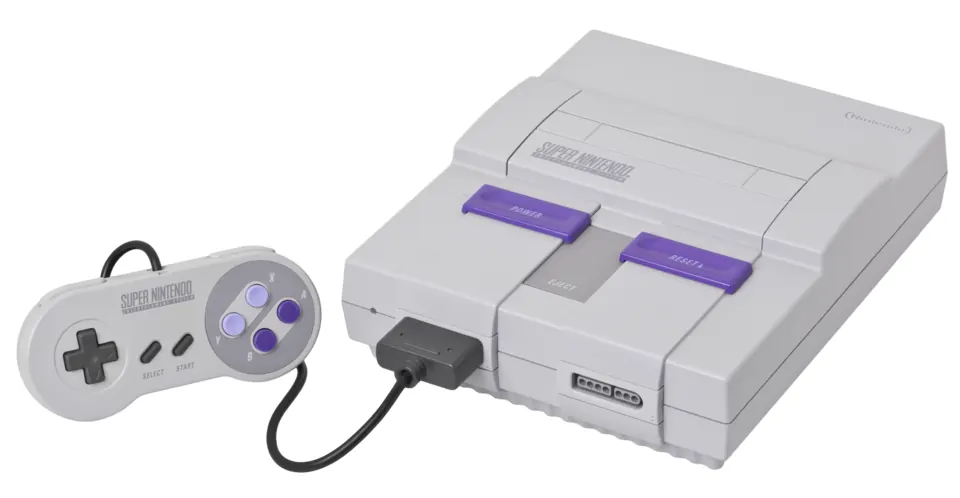
The pinnacle of 16-bit gaming craftsmanship. With Sony engineer Ken Kutaragi’s SPC700 audio processor and Mode 7 rotation and scaling graphics, the SNES became the ultimate home of timeless JRPGs, platformers, and adventure epics.
The SNES proved that 2D art could be timeless. Decades after release, pixel art masterpieces like Chrono Trigger and Super Metroid look and play as gorgeously as the day they were manufactured.
Under the hood
- CPU
- Ricoh 5A22 (WDC 65C816 16-bit core) @ 3.58 MHz
- Sound chip
- Sony SPC700 + S-DSP 8-channel 16-bit stereo ADPCM audio processor (Engineered by Ken Kutaragi)
- Graphics
- PPU1 & PPU2: Mode 7 pseudo-3D affine rotation/scaling, 256 colors from 32,768 palette, transparency blending
- Media
- ROM Cartridges with optional coprocessor chips (Super FX 3D chip, SA-1)
Hardware revisions
| Model | Years | What changed |
|---|---|---|
| SNS-001Super NES (North America) | 1991-1997 | Multi-chip design; boxy North American case with purple sliders; Known issue: Early units prone to graphics glitches and controller-read faults from board degradation |
| SNS-101Super NES Jr. ('New-Style SNES') | Oct 1997 | Consolidated single-chip design, smaller form factor, eject button removed; Known issue: Loses the bottom expansion port, so it's incompatible with the Satellaview add-on |
| SHVC-001Super Famicom (Japan) | 1990-1997 | Japanese-market equivalent of SNS-001, using Nintendo's Japan-specific SHVC prefix rather than SNS. |
| SHVC-101Super Famicom Jr. (Japan) | 1998 | Japanese-market equivalent of the SNS-101 New-Style SNES. |
What it cost
only about 6% of a month’s pay in 1996 · about $200 today
| US launch list price ($199 with Super Mario World) |
$199 (1991)
only about 11% of a month’s pay · about $458 in today's money |
|---|---|
| SNES Jr. redesign price ($99.95) | $99.95 (1996) |
| Super Famicom launch price (¥25,000) | ¥25,000 |
| Units sold | 49,100,000 49.10 million units worldwide. |
What it's worth now
Moderate $80–120 loose, $200–400+ boxed
Mainstream and well-supplied; value climbs sharply for boxed units and late-run rarities.
A guide to collectibility, not a valuation — real prices depend on condition, completeness and demand.
Why it mattered
The SNES proved that 2D art could be timeless. Decades after release, pixel art masterpieces like Chrono Trigger and Super Metroid look and play as gorgeously as the day they were manufactured.
Emulating it today
| Emulators | bsnes, Snes9x, ares, Mesen-S |
|---|---|
| Setup effort | Trivial to run (0 on this site's scale) |
| Controls | A standard modern controller covers the ordinary controls, though unusual accessories may need custom mapping. |
| Runs on a handheld | Yes |
Flawless, 100% cycle-accurate plug-and-play emulation on Snes9x and bsnes/Ares cores. The emulator names above are starting points, not a promise that every title or accessory behaves identically. Computer platforms usually add model selection, disk handling and keyboard setup even when CPU emulation itself is mature.
Firmware
This system needs no firmware file. Install an emulator, open a game, and it runs.
How many files you need: none to go and find. No separate firmware file is needed for an ordinary setup.
Firmware details checked 2026-08. Emulator requirements change — see Libretro documentation for the current list.
Where the software is
Preservation catalogues describe verified dumps; they do not grant permission to download commercial software. A curated, correctly matched set is easier to use than an undifferentiated archive.
Copyright: Commercial software remains copyrighted unless its owner explicitly released or relicensed it. Homebrew, public-domain programs and current reissues should be treated separately from abandoned commercial titles.
This site names preservation projects and explains what they are. It does not link to ROM downloads.
Where to start
- Super Metroid Action Adventure / Metroidvania
The gold standard of environmental storytelling, non-linear progression, and atmosphere.
- The Legend of Zelda: A Link to the Past Action Adventure
Defined modern Zelda with the dual Light/Dark worlds, dungeon puzzles, and orchestral score.
- Chrono Trigger JRPG
The Dream Team (Sakaguchi, Horii, Toriyama, Mitsuda) created the greatest time-travel RPG ever made.
- Super Mario World Platformer
Introduced Yoshi, 96 secret exits, and the world map standard.
- Final Fantasy VI (III US) JRPG
Nobuo Uematsu’s opera scene, Kefka’s apocalyptic madness, and an unforgettable ensemble cast.
- Donkey Kong Country 2: Diddy's Kong Quest Platformer
David Wise’s atmospheric "Stickerbush Symphony" and pinnacle Rareware platforming.
- Super Mario Kart Kart Racing
Mode 7 pseudo-3D rotation invented the kart racing genre.
- Mega Man X Action Platformer
Dash mechanics, wall kicks, and explosive guitar rock energy.
- EarthBound (Mother 2) RPG
Shigesato Itoi’s quirky, heartfelt modern-day Americana satire.
- Street Fighter II Turbo Fighting
The definitive home conversion that anchored fighting game tournaments in living rooms.
- Donkey Kong Country 1994 Platformer
- F-Zero 1990 Racing game
- Breath of Fire 1993 Role-playing
The verdict
The undisputed golden zenith of 16-bit 2D pixel art. Super Metroid, Chrono Trigger, A Link to the Past, Final Fantasy VI, Super Mario World—nearly every flagship title is an immortal masterpiece.
The strongest software can be rewarding, but original controls and setup assumptions may matter more than screenshots suggest.
- Worth it if
- Players curious about nintendo home consoles, 8- and 16-bit and willing to learn how the original machine worked.
- Not for
- Anyone who wants a large, instantly accessible library and no model, firmware or control decisions.
Scored 5/5 for fun today and 5/5 for historical importance. Those two scores decide the label at the top — a machine can matter enormously and still be no fun.
Read more & watch
This page is 75% complete against the facts we try to record for every system. Gaps are shown as gaps.