1982 · Sord · Japan · console
Sord M5
A small Japanese home computer with an odd second life in Europe.
Mixed Trivial to run ▶ Watch on YouTube ↗
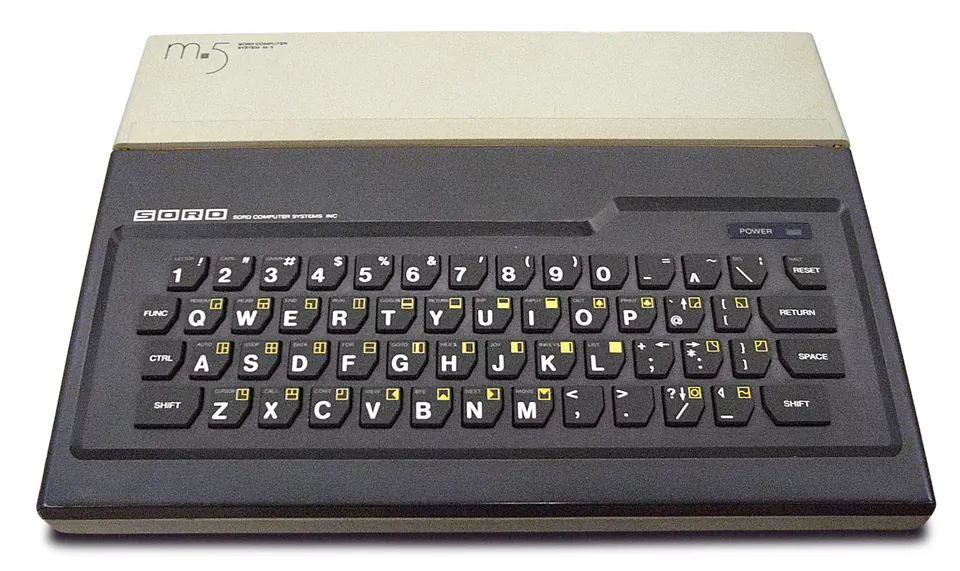
Image: Ubcule, based on a photo by Liftarn · CC BY-SA 2.0

A 1982 Japanese home computer from Sord, small and cheaply made, with a modest library and a curious afterlife being sold in Britain and Czechoslovakia, where it found rather more of an audience than it ever did at home.
Its games were few and mostly ordinary ports; the machine survives now as a footnote even among enthusiasts, kept alive by a handful of collectors.
What it cost
about 16% of a month’s pay in 1982 · about $648 today
| Japan launch price (¥49,800 / ~$200 USD) |
¥49,800 (1982)
Z80 Japanese home computer with TMS9918A VDP and SN76489 sound. |
|---|---|
| Typical street price | — No verified mass-market street price recorded yet. |
| Units sold | ≈100,000 estimate Estimated 100,000 units sold in Japan and UK (CGL M5). |
Why it mattered
The M5 is a minor Japanese machine with an unexpected second life in Britain and behind the Iron Curtain — a small illustration of how hardware found audiences in unlikely places.
Emulating it today
| Emulators | MAME (m5 driver) |
|---|---|
| Setup effort | Trivial to run (1 on this site's scale) |
| Controls | A standard modern controller covers the ordinary controls, though unusual accessories may need custom mapping. |
| Runs on a handheld | Yes |
The emulator names above are starting points, not a promise that every title or accessory behaves identically. Computer platforms usually add model selection, disk handling and keyboard setup even when CPU emulation itself is mature.
Firmware
This system needs no firmware file. Install an emulator, open a game, and it runs.
How many files you need: none to go and find. No separate firmware file is needed for an ordinary setup.
Firmware details checked 2026-08. Emulator requirements change — see Libretro documentation for the current list.
Where the software is
Preservation catalogues describe verified dumps; they do not grant permission to download commercial software. A curated, correctly matched set is easier to use than an undifferentiated archive.
Copyright: Commercial software remains copyrighted unless its owner explicitly released or relicensed it. Homebrew, public-domain programs and current reissues should be treated separately from abandoned commercial titles.
This site names preservation projects and explains what they are. It does not link to ROM downloads.
Where to start
- Star Fighter 1983 shooter
- The Castle 1985 action
A rare M5 game that also appeared on bigger Japanese machines.
The verdict
A curiosity with a small library; mainly of interest to collectors.
Its catalogue is thin and ordinary — there is little reason to choose it over its contemporaries.
- Worth it if
- Players curious about educational machines, oddities and fantasy consoles and willing to learn how the original machine worked.
- Not for
- Anyone who wants a large, instantly accessible library and no model, firmware or control decisions.
Scored 3/5 for fun today and 3/5 for historical importance. Those two scores decide the label at the top — a machine can matter enormously and still be no fun.
Read more & watch
This page is 50% complete against the facts we try to record for every system. Gaps are shown as gaps.